
Thiru-āvinankudi Krishna Sundaresa Iyer
%subtitle%
- 1896 – Born
- 1908 – at age 12 first has darshan of Bhagavan in Virupaksha Cave
- 1915 – at age 19 permanently begins to reside in Tiruvannamalai
- 1918 – at age 22 meets Kavyakantha Ganapathi Muni
- 1918 – Bhanu Sharma was born; TKS’s wife passes away five days later; baby was raised in Sanipoondi village near Tiruvannamalai
- 1920 – Kavyakantha comes to reside in Tiruvannamalai
Studies Vedas under Kavyakantha for 8 years Made General Secretary of Mahendra Societies – 10,000 members: objective – win freedom by devotional means: rituals, prayers, personal and collective penance. - 1925 – Bhanu Sharma comes to Tiruvannamalai; TKS marries again, and two more children are born – Arun Sharma; Sundari.
- 1927 – Preface for Nool Thirattu
- 1929 – Kavyakantha leaves Tiruvannamalai
- 1929 – Deepavali – Ganga Snanam
- Kaivalya Navaneetham
- Tiff with Sarvadhikari
- 1933 – May: Prayer in Tamiḷ viruttam style – darshan of Rama
- 1947 – The crumbled dosas
- 1948 – Puri Shankaracharya
- 1965 – Absorbed in Arunachala on Friday, February 5th at 6:10 AM in Ramana Nagar.
Most devotees remember him as the serene bearded devotee clinging to a book or two of Bhagavan’s teaching. The paradigm that he adopted for his life was “One Guru, One mantra and One book”.
But it was not always that way for him. This was the culmination of a beautiful spiritual journey that he undertook. Walking alongside him through the bits and pieces of information about his life and struggles, we can learn not just about his journey but also take hints to overcome our own struggles as well.
T.K.Sundaresa Iyer hails from a poor brahmin family. He was born in Tiruvannamalai around 1896, the year Bhagavan came to Arunachala. In his reminiscence, he states that his cousin Krishna Moorthy was deeply devoted to Bhagavan and would often visit him in Virupaksha cave.
Around 1908, at the age of 12 his curiousity peaked and he accompanied his cousin to have a darshan of Bhagavan. There were around 10 devotees and some were singing from Devarams. Looking at him, Bhagavan asked, aren’t you going to sing. Young TKS sang a Sundarar devaram. The gist of the song is “Having given up everything, I have sought refuge in you, seeking relief from cycle of birth and death. O Lord, pray even if my intellect forgets you, let not my tongue forget to chant your name” Bhagavan smiled, nodded and acknowledged that it was indeed enough to remember the name!
That he should utter this particular devaram is no coincidence. More about that later...
The young boy was totally captivated taken by Bhagavan’s presence and made it his daily habit to come and drink deeply in the peace Bhagavan that exuded there. Many years later, he recalls that though they ran up the hill to see a physical being, that in His presence, he saw Bhagavan shining like a golden effigy beyond the common realm of human existence.
The initial surge of energy and curiosity abated and the young boy noted that nothing tangible was happening to him. Disappointed, he quit going up the hill. However after about three months, he was feeling miserable, he felt incomplete and lost. He tearfully rushed back and asked for forgiveness. Bhagavan had noted his absence and after their short conversation he made his first spiritual discovery. Guru’s presence may not add anything new, but his absence was certainly a greater loss.
He was drawn to the ascetic life during his teen years and he even went for bhiksha and shared with the sadhus in Virupaksha. By 1915 he finished school and gained employment as a teacher. Money was always hard to come by and he could not pursue any higher education. However, the proximity of Bhagavan was his blessing and he never missed an opportunity to be with Bhagavan. One time he came to the cave but was embarrassed that he had nothing to bring to Bhagavan as an offering. Bhagavan reassured him and he received his next spiritual lesson when Bhagavan reminded him that bringing his self to Him is the biggest offering!
What a beautiful lesson for all of us when we eagerly want to do this, bring that, and be drawn to all the worldly norms and paraphernalia. "". said Bhagavan and that is exactly what TKS strove to do from that day.
Pursuit of knowledge - Guidance of Ganapati Muni
1918-20 was a time of social awakening in India. TKS was in his early 20s. In his reminiscenceso he states he was drawn to Bala Gangadar Tilak and was not particularly confident that Mahatma Gandhi’s approach would work. He also believed that spiritual awakening had to happen at grass root levels and he used up all his spare time during weekends teaching Periapuranam/a> in different villages.
Soon his path crossed Vasiṣṭha Kavyakantha Ganapati Muni, this time they had a political debate. He and the Muni agreed on the importance of spiritual awakening and invoking divine intervention to strengthen their freedom struggle. Ganapati Muni was inspired to start a movement called “Mahendra Society” and made TKS the general secretary. It had branches all over India and remarkably they were able to recruit almost 10,000 members.
In 1920 Kavya Kantha moved to Tiruvannamalai as the head of the local congress movement. He started living in the Mango Tree cave which was a stone’s throw from Virupaksha. In spite of being a serious intellectual, TKS did not get opportunities for higher education because of financial struggles. He was always wonder struck listening to the conversations and expositions between, Kavya Kantha and Siva prakassm Pillai.
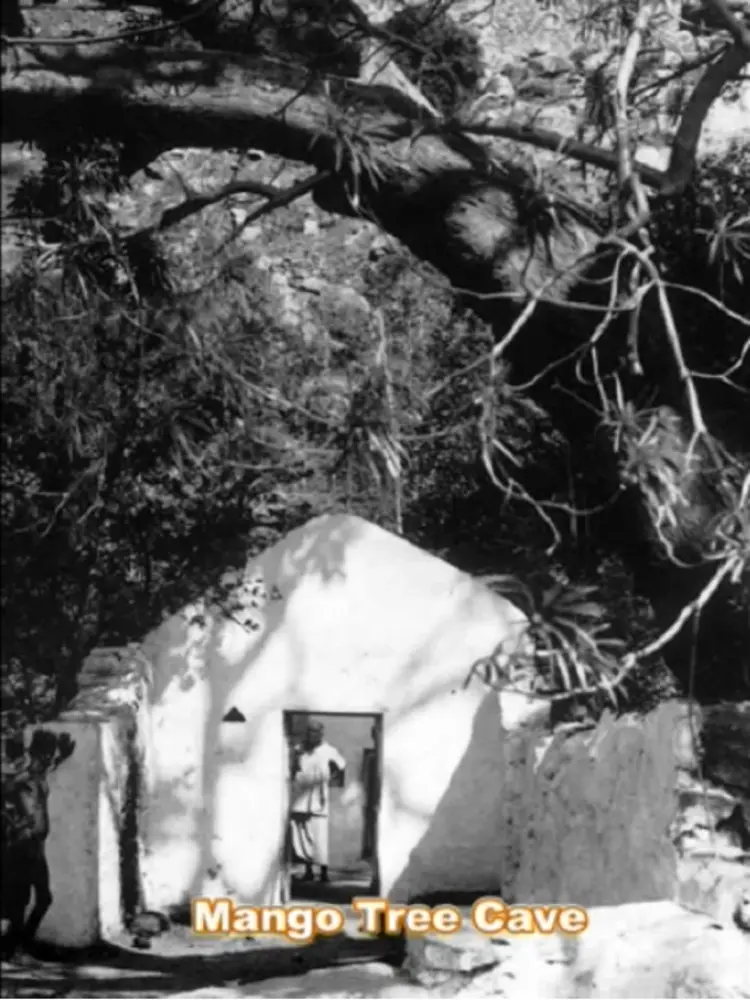
When Kavya Kantha moved to Tiruvannamalai, Bhagavan bade TKS to learn the meaning of Vedas under the tutelage of Kavya Kantha. TKS spent the next decade practically living with him in the Mango Tree cave, while balancing his job as a teacher and his responsibilities as a householder. Kavya Kantha’ s social interpretation of the Vedic tradition and his progressive views on society must have had an impact in him. In his later years he remarks about a conversation that had left a deep impact on him. Kavya Kantha, who had encyclopedic knowledge of Vedas and complex theories pertaining to many aspects of life told him that all the voluminous information suddenly makes sense after hearing just one word from Bhagavan. His dependence on Bhagavan for such clarity slowly weaned TKS from his endless pursuit of raw scriptural knowledge.
What’s in a name – TKS
We wanted to analyze his initials. It is easy to assume that T would stand for Tiruvannamalai since he was born and raised there. However upon asking around we came to know that T actually stands for Thiru-āvinankudi, another name for Palani.
T.K.Sundaresa Iyer often signed his name a Sundara Krishna Vasishtan.
Why Vasishtan? He lived in a time when people did not want to carry on the sect identification so obvious in their name; especially advaitins and seekers of Self aggressively removed identities. Kavya Kantha with whom he spent almost a decade was also a great social reformer. TKS was in his late teens when he saw Kavya Kantha.
Around this time he likely changed his name to Sundaresa Krishna Vasishtan. Vasishtan may be his gotra name. The next extrapolation happens when his first son was born in 2019. Vasishta munivar represents the Sun dynasty and supporting this conclusion, TKS named his son Bhanu[1] Sharma, . His wife died 5 days later. Trying to raise a motherless baby was a daunting task. No relatives came forward to help. In his reminiscences, Bhanu Sharma states that he was left in the care of maternal grand parents in a village at the outskirts of Tiruvannamalai. In a very moving statement, he declares that he was nursed during infancy and toddlerhood by multiple women of varying sects. He came back to live with his dad, TKS in 1926 at the age of seven.
Ganapati Muni was a strong believer in householder dharma and encouraged all his disciples to marry. We can only guess that TKS, who barely felt the need to go home or pursue his householder duties, was convinced to marry second time. By the time Bhanu Sharma came back to Tiruvannamalai to pursue his studies, he had two step siblings, a brother called Arun[2] Sharma and Sundari.
The proximity to Bhagavan and Kavya Kantha afforded TKS the unique opportunity to witness some of the miraculous events that happened during that time, like the kapala bhedham of Kavya Kantha. He was there when Sri Ramana Gita was composed and during Alagammal’s Maha samadhi and the establishment of the fledgling Sri Ramanasramam.
The entire Arunachala Stuti panchakam was composed during those years. In fact his life changing “Nool Thirattu” which is a collection of all the written work of Bhagavan was prepared for publication during this time.
1929 was a pivotal year. Kavya Kantha moved lock stock and barrel to Sirsi and TKS felt a bit distraught. Earlier, when Kavya Kantha was in the ashram with him, he would rejoice in the great conversations that took place. Kavya Kantha had once he told him “When the resplendent sun of knowledge is shining in front of you, don’t close your eyes, keep it open and see divinity up close and personal.” Following this advice he later recalled that he had multiple visions of different Godheads and that reassured him of his spiritual progress.
Now, without his teacher, he felt a bit lost and lamented about his predicament to Bhagavan. He frequently entertained thoughts of taking up sanyasa but Bhagavan forbade it and instead asked him to read a few specially selected verses from Kaivalya Navaneetha. TKS steadily calmed down and spent every waking moment that he could spare between work and some household duties to be in the presence of Bhagavan. That year on the day before deepavali he was lingering in the ashram when Bhagavan asked him to go home to his family, spend the night, do the Ganga bath in the morning and return back to ashram. TKS reluctantly left and once he got home, woke all the family up at 2 am, quickly finished the ritualistic bath and rushed back to the ashram to be in his presence dawn hours. The glow of the moonlight, the mountain etc made him see Bhagavan as Lord Nataraja.That vision filled him with joy.
From the beginning of the 30s, he was playing a very important role in the day to day happenings of the Ashram. Given his linguistic skills, he was an able translator for ashram visitors and he also helped with ashram correspondence with utmost sincerity. He was also witnessing some of the most wonderful discourses and discussions.
Yet, in May 1933, on his 36th birthday, he hit another low point. He felt with all these years in ashram at Bhagavan’s feet, he still had not gained clarity. He put his feelings in a Tamizh verse and handed it to Bhagavan:
இன்று யான் பிறந்தே ஏழைந்தாண்டாயிற்றே
என்று யான்பிறப்பேன் இறை ரமண இதயத்தே
என்று யான் இறப்பேன் இறவாத சிறப்பதனில் என்று நான் இறக்க இரங்கும் அருட்கண்ணேயோ
“I have completed 35 years, when will I be born in the Ramana heart lotus, and when will I die into the deathless space, when will Thy Grace destroy my ego.” Upon reading it, Bhagavan asked him to sit down and gazed at him. TKS later recalls vividly this experience. He states he went into a deep meditative state and he had the most amazing vision of his favorite personal Godhead Rama with his spouse Sita, and Hanuman in the brilliant coronation scene. After staying in that state for awhile he came back to his senses. Bhagavan asked him to pick up and read the Dakshinamoorthy Ashtothram from the revolving book shelf. He came across the Nama where Yoga rama is said to be the equivalent of Dakshinamoorthy. Bhagavan smiled at this observation.
Slowly but surely, the multiplicity of visions as a simple exercise of mind and the enduring Self as unchanging singular truth was blossoming in his heart. The profound truth of All is one was sinking in.
Still, there were a few more hurdles to cross, the impact of Guru’s Grace yet to be felt…

Ramanasramam days &ndash, #.2
1929-39 were according to TKS his years of steady spiritual development. He spent a great amount of time in Bhagavan’s presence.
Once on an amavasaya (new moon) day, Bhagavan was busy in the kitchen making idlis and when TKS passed by he asked him to eat some. Steeped in tradition, TKS hesitated and then blurted out to Bhagavan that since it was amavasya, he had to do rituals for his forefathers before he consumed any food. Bhagavan declared that all his forefathers had reached where they needed to reach and all such rituals were unnecessary. Upon hearing this, TKS gave up doing rituals for the rest of his life. Bhagavan’s singular love for him was becoming more and more apparent to him.
Once Niranjananda got upset with him and as he was scuttling away Bhagavan invited him to eat. Not wanting to be in the visual range of the sarvadhikari, he told Bhagavan that he needed to go to the school to help some students. Bhagavan balked having caught him in the lie since it was a Sunday and sheepishly TKS ended up dining in the ashram. Sundaresa as Bhagavan lovingly addressed him literally went through his teen years and transitioned to a young adult in front of Bhagavan.
Recalling all his memories recorded in the memoir “At the feet of Bhagavan”, TKS states that he is sharing only ones that left an indelible mark so far removed in time. Here is one such:
In 1933, TKS was part of the group that went on a walk with Bhagavan to Samudram lake. On that leisurely walk Bhagavan pointed to a palm tree that has let a banyan sprout from it. Using this peculiar natural phenomenon, Bhagavan described Guru’s grace.
Guru’s grace falls unbeknownst like a banyan seed through a bird dropping on a young palmyra. The banyan seed grows deep into the palm tree and soon the palm tree ceases to grow and the banyan takes over. Such is the power of the Grace and it erases the tendencies of the disciple and soon the Guru shines through the disciple. This metaphor was transformative for TKS . After the walk, he composed a verse expressing his understanding. The beauty of the verse speaks for itself.
பனைத்தருவில் ஆல்விதையைப் பறவையினம் எச்சமிடப்
பனையழிய ஆல்ஓங்கும் பாங்கெனவே பழம்பாச வினைத்தருவாம் அகந்தையினில் வினைகடந்தான் அருள்படவே
வினையகந்தை வேரழிய விண்ணுள்ளம் ஓங்கிடுமே.
During the same walk, Bhagavan also stopped in front of the sluice gates and again used it as a metaphor for the intensity of Guru’s Grace. He stated depending on the need, the gate should be opened since a full blown open gate may drown and destroy crops instead of helping it grow. Such is the intensity of Grace and the readiness of the disciple to accept it. Everything started to make sense to him.
His craving for multiple godheads had vanished and his conviction in one single guru had taken root. He now needed a mantra. Chanting the holy name of a godhead was very deep rooted in him and that is where the next transformation took place....p>