

Sub-Registrar Narayana Iyer
R.Narayana Iyer was one of the senior-most devotees of Sri Bhagavan. Soon after he came to Bhagavan, he began to move with him more like a resident of the ashram than a casual visitor. Initially, he was a hardened sceptic with ultra-modern views and ways but very soon he became a staunch follower and a devotee of Bhagavan.
Narayana Iyer was born in 1899 at Salem to Ramachandran and Smt.Kamala. He had two younger brothers: Subramaniam, the elder, Srinivasan the youngest;. two sisters, Swarnamba and Lakshmi. He had his entire education up to intermediate in Salem, during the period when Rajaji was the municipal councillor of Salem. He then graduated in Bachelor of Arts (B.A.) in Madras Pachaiyappas College in History and Economics. He was a gold medallist in English of the Madras Presidency in the year 1922, which was covering all the southern states at that time. He was drawn to Shakespeare and English literature and was part of the English drama troupe during the school days. He married Smt.Lalithambal in the year 1919.
He had a modern outlook, leading a comfortable and happy life. He was sceptical of sadhus and not much connected with spiritual masters before meeting Bhagavan. He worked as a Sub-Registrar in and around North Arcot Districts - Doosi, Chetpet, Polur, Chengam, and Arni. It was during his Chetpet stint that he visited Bhagavan for the first time. He moved permanently to Tiruvannamalai in 1940/41 and was the first person to construct a house in Ramana Nagar and shifted his family to be near the Ashram. He lived in Tiruvannamalai till the early 1970s and moved to Chennai during his last few years where left his body in 1976 at the age of 77. Smt.Lalithambal lived till the age of 90 in 1996.
Sub-Registrar Narayana Iyer was a fortunately blessed devotee of Sri Bhagavan who received unimaginable and inexplicable attention, care, love and blessings from him. He had an inner experience that affirmed that Bhagavan was God himself. Narayana Iyer said, “It was not my decision; I had become a slave of Bhagavan. I had refused to succumb to any form of intellectual conviction about God. Hence, Bhagavan had to give me the experience that he is God.
Kanakammal related the following about him: “Narayana Iyer was born in rich family, but he was perfectly humble. Narayana Iyer’s wife shared his views and lived her life as her husband wanted her to. When he was at home, he would often be reciting “Ulladu Narpadu” (Forty Verses on Reality) at the top of his voice. He tended to the cows and did gardening. The moment the cow gave birth to a calf, he would give total attention to the cow and calf. As the cow would be giving birth he would recite “Ulladu Narpadu”. In a lighter vein, Narayana Iyer’s wife once told me, “The exclusive privilege of receiving Narayana Iyer’s attention was given to the cows but was never extended to her, the mother of eight children!”
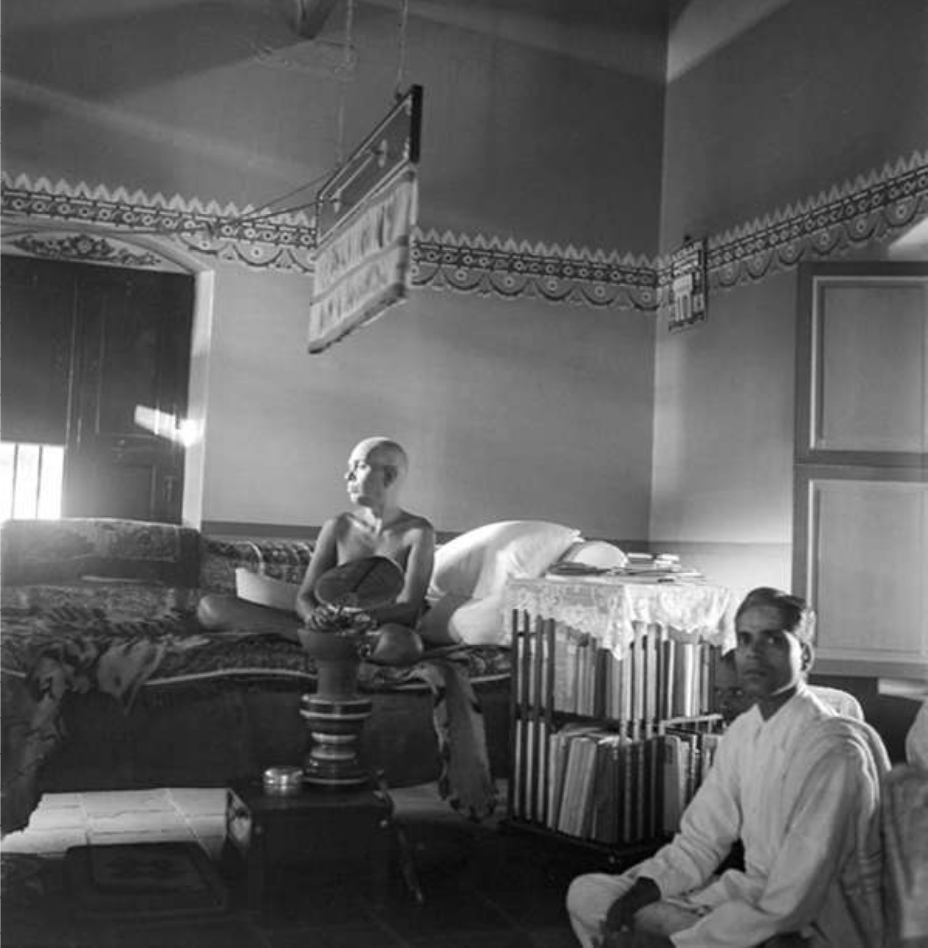
Narayana Iyer’s dedication to and practice of Bhagavan’s teachings was meticulous and total. He was once posted in a place away from Tiruvannamalai. That meant he could not go to Bhagavan whenever he wanted; he was like a suckling baby, longing to be back with the mother. As there were hardly any taxis or buses in those days, Narayana Iyer sometimes hitchhiked on lorries as a mode of transport, reach Bhagavan and would even go back home in the same manner.
Narayana Iyer rarely missed coming to the ashram on Bhagavan’s birthday. Once, he was sixty miles away. He travelled by one lorry after another and at last reached the ashram after midnight. He had to leave the ashram at five that same morning because he had to report for work at nine. While taking leave, he prostrated before Bhagavan. Bhagavan took him to the kitchen. They both looked into the vessels but there was nothing there because everything, including the floor, had been cleaned with water the previous night. Bhagavan went into the small room inside the kitchen and looked into all the pots and pans. Fortunately, he found a handful of almonds. As he came out, he noticed that the kitchen fire was almost out, so he put more firewood into the fire and then set a frying pan on it. He poured some ghee into the pan and then added the almonds and roasted them. He also added salt and chilli powder. He put the almonds on a leaf and gave it to Narayana Iyer, saying, how can you go without eating anything? It seemed heavenly to Narayana Iyer, though he could hardly believe what was happening. He obeyed Bhagavan automatically. Then, Bhagavan got up, looked for a newspaper and another leaf and wrapped up the rest of the almonds in them. He packed it beautifully, just like they do in restaurants. He gave it to Narayana Iyer, saying, “When you go home Lalitha (his wife) and your children will ask, ‘What have you brought us from Bhagavan?’ Take this and give it to them.” As Narayana Iyer narrated this, he wept copiously and said, “How can I not remember the special acts of love? Who will believe it when I talk about it?”
When Narayana Iyer’s eldest daughter was to be married, Narayana Iyer had no money. His wife said, “Why don’t you go and appeal to Bhagavan?” He replied, “I will never go to Bhagavan and appeal for material things.” She prayed to Bhagavan silently, telling him of the importance of the betrothal. The couple then went to see Bhagavan and prostrated before him. They did not breath a word of the matter. The next morning the postman arrived with a money order for fifty-one rupees. It had come from Ahmedabad, a good thousand miles away from Tiruvannamalai. With it was a message saying “letter follows”. The couple bought whatever was needed with the money. The prospective bridegroom came and was received well and a wedding date was fixed. The couple waited anxiously for the letter that was to follow. The letter arrived later from a Gujarati gentleman from Ahmedabad. The couple did not know him at all. He wrote: “Dear Narayana Iyer, Sri Ramana Maharshi appeared in my dream and told me that I have to immediately telegraph a money order of rupees fifty-one. He gave me your address. I do not know you and I do not know what the money is for. Please accept it.”
Narayana Iyer, his wife and daughter went before Bhagavan. They wept and prostrated before him and said, “What grace are you showering on us!” Bhagavan read the letter as though someone else had showered the grace! He then focused his attention on both of them and said, “Why doubt? Why should you not ask me?”
It is not just for spiritual fulfilment that we have come to the master. When the supreme master is capable of granting you the highest thing, which is Self-realisation, will he not fulfil your prayers for mundane things as well? In a similar context, Devaraj Mudaliar once asked Bhagavan, “Bhagavan, you have praised Arunachala, your father, as being, gracious, compassionate and powerful enough to give Atma sakshatkara. Does this mean that I can even make pleas for my daughter’s marriage or my employment? “Bhagavan smiled and answered, “If a person can grant Self-realisation, is it difficult for him to grant your simple prayer, like getting a job or getting a son? If you have a lakh of rupees, is it difficult for you to give ten?
One day when I was sitting by the side of Sri Bhagavan, I felt so miserable that I put the following question to him: “Is the sankalpa (wish) of the Jnani not capable of warding off the destinies of the devotees?” Bhagavan smiled and said: “Does the Jnani have a sankalpa at all? The Jivanmukta can have no sankalpas whatsoever. It is just impossible.” I continued: “Then, what is the fate of all of us who pray to you to have grace on us and save us? Will we not be benefited or saved by sitting in front of you or coming to you? What use is there then for family men like me to gain by coming here to you?”
Bhagavan turned graciously to me and said: “Just as a trouble (or arrow) that comes to destroy the head goes away carrying with it only the turban, so a person’s bad karma will be considerably reduced while he is in the presence of a Jnani. A Jnani has no sankalpa but his sannidhi (Presence) is the most powerful force. He need not have sankalpa, but his presiding presence, the most powerful force, can do wonders, save souls, give peace of mind, and even liberation to ripe souls. Your prayers are not answered by him but absorbed by his presence. His presence saves you, wards off the karma and gives you the boons as the case may be, involuntarily. The Jnani does save the devotees, not by sankalpa, which is non-existent in him, but only through his presiding presence, sannidhi.” I was filled with joy Even today his presence is the most Powerful thing and that alone, I am confident, saves me!
Sri Eswara Swamigal of Tiruvannamalai
For over several thousands of years Tiruvannamalai in Puranic literature as Arunachala has been a famous place of pilgrimage. This great sacred spot has instilled devotion into several souls and in addition to that it has also produced several highly evolved souls who have illuminated the spiritual firmament of our sacred mother land. Among such luminaries we had in our midst Bhagavan Sri Ramana Maharshi, Sri Swami Seshadri and other great souls. This line of spiritual hierarchy had also in our midst till quite recently, in the embodied existence of the sacred personality known as Eswara Swamigal.
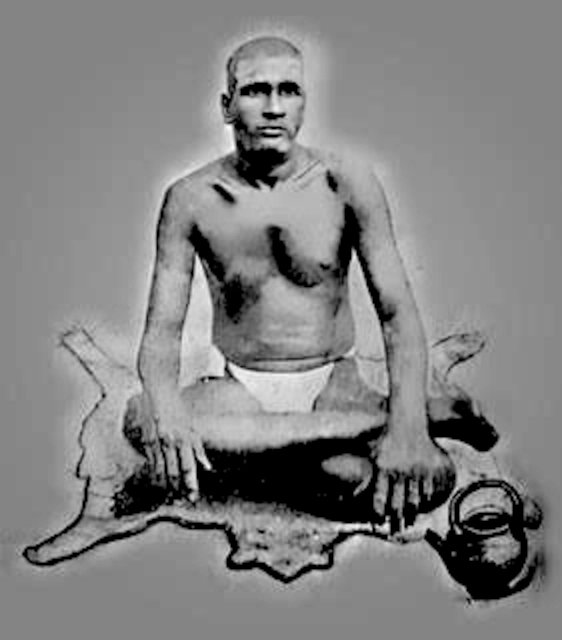
Sri Eswara Swamigal was born on 22nd November 1880, in a village in South Arcot District. Even while he was young, he was brilliant in his studies. In addition to learning the Vedas according to the family tradition, he was fairly proficient in astrology, astronomy and medicine. He was also proficient in both Sanskrit and Tamil, and had natural talents for poetic compositions. Though he was leading a happy and peaceful family life at Tirukkoilur, and was above wants, he found solace only in Atma Jnanam and was almost always lost in meditation. He used to sit beside the river near Tirukkoilur and concentrate on Arunachala which was visible from there. He took Arunachala itself as the center of his aim and got happiness, bliss, sweetness and joy from such meditation without actually doing hatha yoga or similar yogic practices. He concentrated on the inhaling and exhaling of breadth and was deeply engrossed in Self-enquiry.
Before he was 30 years of age, his parents and dear relatives attained the feet of the Lord, and being freed of all mundane ties, he came to Arunachala on the 28th February 1911, the day of Maha Sivaratri. From that date he continued to stay at this sacred sthala till his Mahasamadhi in July 1958.
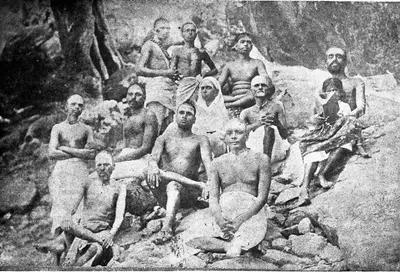
He was dwelling in the caves of the hill and living in isolated places for a number of years. Sri Eswara Swamigal and Bhagavan Sri Ramana were practically living together in Virupaksha cave, Skanda Ashramam, and various other places. Together they used to perform Giripradakshinam occasionally. It was only in 1922, that Sri Ramana shifted his Ashramam. The very fact that\ Shuddhananda Bharathi in his foreword to the book Arunachala Mahatmyam compiled by Sri Eswara Swamigal as early as 1928 has expressed that Eswara Swami is loved by Ramana, is ample testimony to the high esteem in which Sri Ramana had for Eswara Swamigal. Also, Sri Seshadri Swami used to express that Eswara Swami “is great...he is an avadhuta....He has come from the mountains.” The omniscient trio of Ramana, Seshadri, and Eswara were living in close proximity to one another in the same town from 1911 to 1922, radiating asceticism, tapas, and siddhis marvelous in themselves. Brushing aside these as little importance, Eswara Swamigal was glowing with Arul Jnana Jyothi.
After living in the caves and on the hill, he was allowed to stay within the Arunachala temple itself for over thirty years. In due course, the Swami gathered around him many worthy disciples and admirers at whose special request, and also with a view to benefit all pious souls for hungering spiritual enlightenment, the valuable Tamil edition of Arunachala Mahatmayam was published in 1922. An English rendering of this work was published in 1951 by the Ramana Satchidananda Mandali, Matunga, Bombay-19.[1]
The saints, sages and avatar purushas purvey to mankind now and then the required spiritual food. Swami Easwara’s was one such feeder of mankind. He established the reality the existence of God, not simply on the ground of scripture or tradition, but on the exposition of the subtle truths about the visible and invisible Universes. The beautiful similes employed by him were very apt and on deep reflection one who came into contact with him would simply be charmed. A study of the various poems composed by him and the answers given by him to several enquiries reveal that the harmony and depth of thought displayed by him were elevating and grand.
It is common knowledge to all how Jatini Shanmuga Yogini was devoted to Swamigal and served him throughout her life with rare Bhakti and one-pointed attention.
After a brief illness (diabetic coma), during which period the best medical aid was administered by his loving devotees, the saint shed his mortal coil and attained Maha Nirvana at 6pm on Friday the 18th of July, 1958. His sacred remains were interred at the southern side of Easanya Mutt. His Maha-samadhi, Guru Pooja, Moksha Deepam and Aradhana were performed on 27th, 28th, and 29 July 1958. Food and clothing were liberally distributed to several sadhus and the poor on the occasion. The unique feeling of the intensity of love, affection and esteem towards the saint witnessed amongst those present was touching to see and moved even strong hearts. The authority of Eesanya Mutt (Sri Ramanatha Swami), the authorities of temple, Sri Kannikeswara Iyer, Banker, Sri Rangachari Advocate, and a host of others were prominent amongst those who guided the celebrations. May the ever-surviving and all-pervading soul of the saint Eswara Swamigal shower his choicest blessings from his immortal abode and guide the humanity in matters not only spiritual but also temporal.
— “The Call Divine,” January 1959God Alone Exists
Those who have realised the Self remain uninvolved, even when they are engaged in everyday activities. They are always in a state of utter stillness. Bhagavan himself has described this in the thirtieth verse of the “Supplement to Reality in Forty Verses”:
"The mind that is devoid of attachments, though it may appear to be engaged in activity, is in reality inactive – just as the mind of a person listening to a story might wander off to a faraway place."
Once, in the Jubilee Hall, we were all listening to the radio. At the end of the program the names of all the artists were announced. Bhagavan said, “See! The radio sings and gives speeches. It even announces the names of the performers. But there is nobody inside the radio. Our existence is also like that. The body might appear to walk and talk and perform a number of functions. But in fact, there is no individual inside the body. Everything is God. He alone exists.” Bhagavan continued, “The concepts of time and space are also imaginary. When we listen to a concert on the radio, are we bothered about the exact time and location at which the concert took place? What difference can it make to our enjoyment of the music? Whether the concert took place in Hyderabad or in Madras, we can listen to the music and derive the same degree of enjoyment sitting right here in this hall.
“The wise one does not attach any importance to concepts of space and time. One has to go through certain situations in a given lifetime and for this a body is required. That is the only reason for acquiring a body. One goes through various experiences without getting involved in anything. To an ordinary person, worldly experiences seem real. An ordinary man might think that a liberated person has all the experiences that others have. But the liberated person has no attachment to the body and therefore physical experiences hold no significance for him.
“The jivanmukta has the same attitude towards his body that a railway porter has for the luggage he carries. Just as the porter carries the luggage up to the destination and lays it down at that spot, the jivanmukta carries the body through the pre-ordained experiences of a lifetime and, at the end of the course, he lays down the burden with relief. The porter thinks of the load on his head only as a burden; he does not identify with it on a personal level. That is why he feels no regret when he puts it down. It is the same in the case of a jivanmukta. As he never thinks of the body as having any personal significance, he feels no sorrow when the time comes for him to leave the body.”
During the last days of Bhagavan’s earthly life, when his devotees beseeched him to retain the human form for a long time, Bhagavan used to say, “A jnani (a realized soul) knows that the sole purpose of acquiring a body is to enable the spirit to attain knowledge through experiences. Do we feel sad because we have to throw away the used leaf-plate after a meal? In the same way, a jnani discards the human body without any regret or sorrow.”
Hometown and Parents
While living on the Arunachala Hill, Eswara Swami wrote the following verse, requesting to know from Sri Bhagavan’s hometown and parents’ names:
Ramana, living in flourishing Sri Aruna, I thought you should ponder and tell your history, at once. Give place of origin and parents’ names for me to know, and when received the world will be fortunate.
In response, Sri Bhagavan wrote:without ever leaving the sunset-coloured One.
However, my father was Sundara, of tree-surrounded Tiruchuzhi
and my mother was Alagamma, the worshipper of his Feet.
For peace and ultimate realization, one needs to dedicate oneself to the practice of meditation taught by Bhagavan Sri Ramana Maharshi. Those who take up this ideal wholeheartedly will find that there exists a family of aspirants from all walks of life whose hearts naturally open up with happiness and joy in the company of other devotees on this path. In the following two reports we read how this interaction serves to enliven and inspire those gathered with faith and devotion.

The Tampa Ramana Jayanthi Retreat
On 29 December 2016, Bhagavan’s Grace, working through many devotees, made a dream come true. The dreamer was Mathy Rathinasamy and the dream was to create an exact replica of Sri Ramanasramam’s Old Hall[2], where Bhagavan held court for over 20 years, in Tampa, Florida, USA.
Since then, every year, except for a few years during the Covid pandemic, there has been an annual retreat celebrating Bhagavan’s Jayanthi and ringing in the New Year.
2025 marked the 9th anniversary of the inauguration of the new “Old Hall”. It was extra special to have Dennis Hartel back with us because he along with his brother James Hartel played a crucial role in recreating the Old Hall in Tampa.
The program kicked off with a formal Jayanthi Pooja celebration in the Hindu Temple of Florida. A group of volunteers set up the shrine on the dais where the pooja took place. Led by Sri Guru Dutt, one of the temple priests, a group of sincere rithviks started the program with the chanting of the Vedas. This was followed by abhishekham to the lingam by the priest and individually by everyone present in the audience. As the alankaram (decoration) was being done, there was a robust chanting of Aksharamanamalai and Arunachala Pancharatnam. The hall was reverberating with the joy and presence of Bhagavan. The retreat was officially underway.
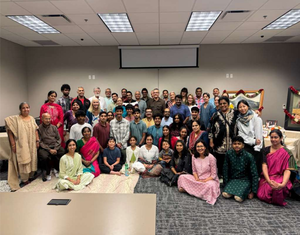
This year a separate conference center in a corporate building was rented for the retreat. The volunteers set up a shrine and thereby transformed it into a peaceful prayer hall. On 27th December the program started in the morning with the morning Veda parayanam, followed by readings and meditation sessions. That was followed by “Lalitha Sahasranamam Stotram” chanting.
This year, we had the great opportunity to host Swami Ishwarananda the resident senior monk at Chinmaya Mission, Los Angeles. Swamiji is familiar to many Bhagavan devotees as he has given discourses in multiple online global satangs during the pandemic years. At this retreat Swamiji gave a two-part presentation on selected verses from Sat Darsanam.
With his natural ability to extrapolate the teaching to our day-to-day life, Swamiji kept the attention of everyone, young and old, wrapped around the topic. He led the presentation with ‘Om’ chanting on both days which put everyone in a deep contemplative mood. He concluded his presentation by leading everyone through a brief meditation session as well. The devotees felt blessed to have been engaged in such a focused and devout journey through Sat Darsanam. – one of the primary works of Bhagavan Sri Ramana Maharshi.
In the afternoon, Dr.Nirmala Bharadwaj gave a presentation on 'Women devotees of Bhagavan’. The talk covered three devotees, namely Akhilandamma, T.R.Kanakammal and Ella Maillart. Bringing out the contrast and similarity in the spiritual quest of these three different devotees, the presentation inspired one and all.
The first day’s program concluded with the evening session held at the Tampa Old Hall. The program there started with the
evening Veda parayanam followed by chanting of Aksharamanamalai and Ramana Satguru, and concluded with bhajans followed by meditation. After soaking in the joy of the satsang in the Old Hall, devotees walked over for dinner to the house of Dr.Rathinasamy & Mathy Rathinasamy, which they had graciously thrown open for this occasion.Day two started with the morning Veda parayana, followed by readings, “Lalitha Sahasranamam Stotram” chanting and then meditation. Just like day one, people assembled back for the second part of Swami Ishwarananda’s presentation.
The post lunch session on day two started with a presentation by Dennis Hartel. He spoke about the history of the Arunachala Ramana Mandiram at Nova Scotia that had completed its 50 years earlier in August 2025. Filled with humor and anecdotes, Dennis took us on that journey and deftly handled some questions about his refuge too, in his own inimitable style.
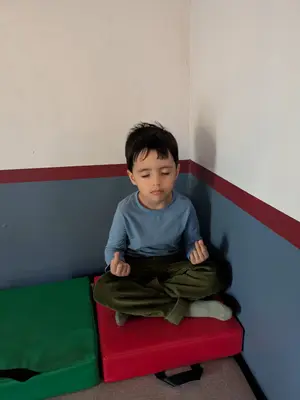
The youth retreat this year involved self-reflection through reading books on Bhagavan. A mini-collection of books was kept for them to read and reflect upon. Most of the young adults actively participated being the foot soldiers, enabling the smooth running of the event. They helped with paring fruits for prasad, running grocery errands, setting up and maintaining the water station, bringing the catered food to the location, helping with set up and cleanup. In addition to this they also did some artwork and short videos highlighting their interpretation of Bhagavan’s teaching. On the evening of day two they put together an audio-video presentation compiling everyOne’s work starting with a delightful chanting of “Upadesa Saram” by Jay Singh, a blessed and enthusiastic 4-year-old. This was followed by more musical presentations and a compilation of the short videos they had recorded. There was also a very engaging trivia session that brought all the attendees together in a hilarious way. The evening program concluded with a brief bhajan session.
On the morning of December 29th, the final session of the retreat included Veda parayanam, readings, “Lalitha Sahasranamam Stotram” chanting and meditation.
This annual retreat is a true blessing from Bhagavan who has chosen to anchor His Old Hall here in Tampa. Every year, Bhagavan works His miracle through many devotees, and this year was no different. We thank everyone that made this event possible.
om namo bhagavate śrī ramaṇāya
146th Jayanthi Celebrated in
the New York Arunachala Ashrama
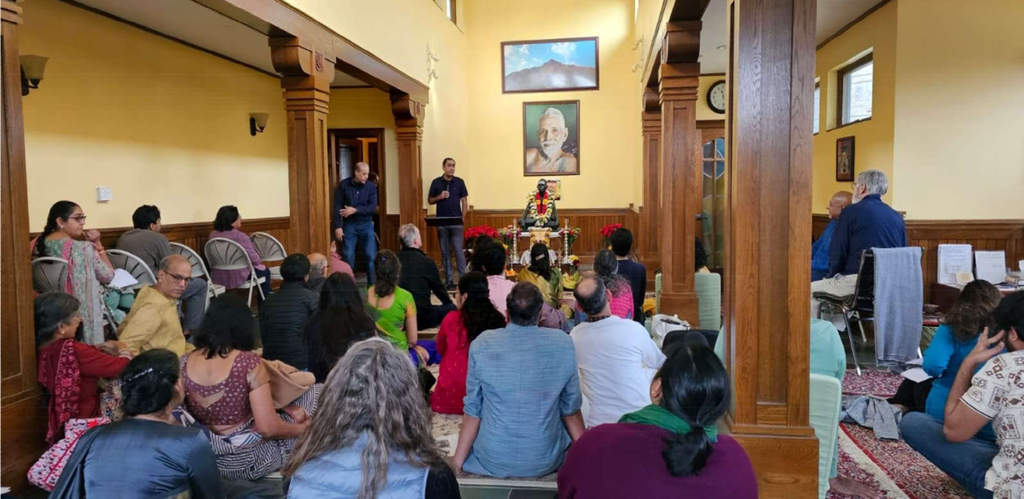
On January 3rd, 2026, devotees gathered at the Arunachala Ashrama in Queens to celebrate the auspicious occasion of Bhagavan’s Jayanthi. The atmosphere was set by the collective recitation of “Aksharamanamalai,” Bhagavan’s heart-melting hymn glorifying Arunachala as both Guru and Supreme Divinity.
Sri Swaminathan served as the program’s presenter, sharing translations of Bhagavan’s verses originally composed for the very first Jayanthi organized by
Vasudeva Sastri in 1912. These readings served as a powerful reminder of the birthless Self as the ultimate reality. Dr.Aruna Ramanan offered a vivid retrospective on the August 2025 Kumbhabhishekam, sharing moving anecdotes from Sri Ramanasramam that brought the spirit of the holy hill directly to the assembled group. Hari Moorthy gave a presentation on the life of Sadhu Natanananda. He highlighted Natanananda’s 1953 compositions dedicated to MuruganarAfter the program the devotees shifted to the main house where a delightful meal, prepared by numerous families for the event, was served. The gathering melded together in an atmosphere of warmth and friendship, as many lingered well into f the late afternoon while Vedic chanting resounded from the shrine and meditation hall.
[1] The 1928 Tamil edition of this book is in Sri Ramanasramam’s library, and the 1951 English edition, with a preface by Major Chadwick, is in the Nova Scotia Arunachala Ashrama library.