

Arunachala Ramana Mandiram – a Dream Fulfilled
Fifty years ago, the temple at Arunachala Ashrama in Nova Scotia was consecrated, fulfilling the vision of Sri Arunachala Bhakta Bhagawata, whose every breath was dedicated to his guru, Sri Ramana Maharshi. The events leading to the establishment of the temple in the rural environs of the Annapolis Valley are related by Dennis Hartel, who was present as the events unfolded, and who since has been instrumental in assisting in the maintenance of this shrine of grace as a beacon light for all sincere seekers and devotees.
We would see him pacing, walking around the circumference of the 100-by-100 foot lot, reciting something in low tones. He was reciting the Lalita Sahasranam Stotram, praying to his Master and Lord, Bhagavan Sri Ramana Maharshi, that he might fulfill His devotee's dream of building a temple dedicated to Arunachala Ramana in this foreign land, on this very spot. This is what we observed during ’s early visits to the Nova Scotia Arunachala Ashrama in 1972, 1973 and 1974. He documented all his 79 trips to the Ashrama in Canada over the next 25 years. And after we first opened the Nova Scotia Ashrama in the spring of 1972, the construction of the temple was the single mission that seemed to fully occupy his devotional aspirations.
It was his inspired desire that the West should become aware of the Divine Presence and direct teaching of Bhagavan Ramana, and for him building a temple dedicated to the Sage of Arunachala was only the beginning.
The first crack in the door, opening a way to fulfill this dream, came at Sri Ramana Maharshi’s Advent at Arunachala anniversary celebration which took place in the Nova Scotia Ashrama barn on September 1st, 1974.
It was Mr.B.K.Raju, a Harvard-educated businessman devotee from Halifax who said, after the program, “Perhaps next year’s celebration will be in a building dedicated to Sri Ramana. He will have his own temple.”
Mr.Raju was known for planning whatever he undertook with meticulous care. He knew we had no funds. We were young, had no experience in fundraising, nor desired to undertake such an endeavor. But he had a plan. Through a network of friends he would raise the money as loans which would be honoured at some point, but how we were to honor those loans was not at all clear to us at the time. What was clear however, was Sri Bhagavan's hand at play, and so we played along as well.
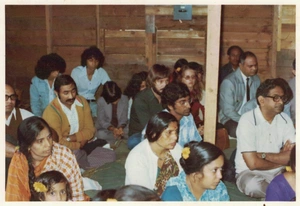
Now we need to travel back in time to the year 1879. Yes, it was the year that Venkataraman, later to be known as Bhagavan Sri Ramana Maharshi, was born in Tiruchuzhi, in Tamiḷ Nadu. And, remarkable as coincidences can be, a corner lot from Dr.Sanders' property – the present Ashrama property on which the temple stands today – had been deeded over to the School Board of Annapolis County. A one-room schoolhouse was opened the very same year – 1879. After about 80 years of service it was closed and the local school children were bused to Bridgetown’s new elementary school. The abandoned schoolhouse and property were bought from the school board, and for another ten years the building was used for storage. Then, in 1969, the building was bought by a developer who wanted to use it as a utility building on a ski slope one kilometer east of the Ashrama. The building was moved to the slope. The ski endeavor failed and the hapless, destined building lay vacant and unused until the Ashram decided that this original school building would be the first temple dedicated to Arunachala Ramana in the West.
So, in the early spring of 1975 the schoolhouse – we had no idea at the time that it had been built in 1879 – was moved back to the newly-purchased lot on the corner of Sanders Road and Clarence Roads. Then construction began.
Blindly, with the faith that Bhagavan would provide, the resident devotees pushed forward, purchasing what was required and engaging workers, etc. The fact that their expenses far outpaced resources was a concern, but they believed that if the Master wanted – that if it was actually ‘His will’ that this temple should be built here in Nova Scotia – what was required He would provide. Their youth, inexperience, naivety were all washed over by the ever-present awareness that they were only instruments of His Divine Plan, that with the construction of this small schoolhouse temple, they were establishing a means to immerse themselves in the bliss of Self-realization and become a conduit disseminating the grace and teachings of the Master. To sacrifice even their lives for this cause would have been embraced if that were required. Such was their bhava, or inner conviction, throughout the whole undertaking.
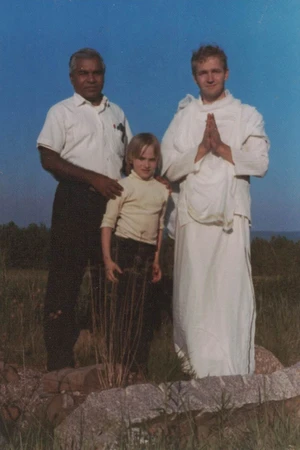
To describe the details of the final financing of the construction and the total cost of the corner-lot property and schoolhouse would require several paragraphs. We can say that after a proper test of their faith, and several miraculous incidents, with the help of devotees and friends, especially that of Lex Hixon, a devotee in New York, all was settled happily. We always will remember that Bhagavan first inspired Mr.B.K.Raju to come forward in answer to Bhakta Bhagawata’s supplications to Bhagavan.
Now, after 50 years, we have come to understand that Sri Arunachala Ramana Mandiram is not just a building dedicated to the Silent Sage of the Holy Hill of the Beacon Light. It is a monument erected for those who wish to still their minds and seek the true and only meaning of who they really are. The Maharshi taught us to leave all our thoughts aside and simply abide as the single I-consciousness, the Self.
His teachings and his ever-present presence welled up in the heart of his devotee, Arunachala Bhakta Bhagawata, took form in a rural community of Canada, and stands after 50 years as a quiet, silent beacon offering light and guidance to those who wish to tread the path that Arunachala Ramana has vouchsafed to the world. May we all, in our hearts, hear that call, tread that path and experience the true meaning and purpose of life.
If they do not understand my silence, they will not understand my words.
— Elbert Hubbard
Advent Day in Nova Scotia
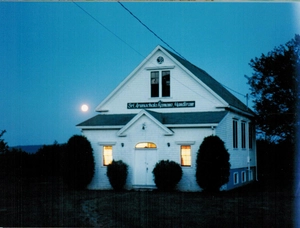
Devotees gathered at the Nova Scotia Ashrama from Georgia, Texas, New York, Ontario, New Hampshire, Chicago and Nova Scotia to celebrate both the 129th anniversary of Sri Bhagavan's arrival at Arunachala on Sept. 1st, 1896, as well as the 50th anniversary of the inauguration of Sri Arunachala Ramana Mandiram that was dedicated to Sri Ramana Maharshi on 01 September 1975.
To begin the celebration, puja was conducted by Dr.D.Subbarao, who also notably conducted, along with Dr.Lakshminarayana, the inaugural puja for the temple 50 years ago. He traveled from Florida along with his son Ravi to be here.
Darlene Karamanos warmly welcomed the attendees. Darlene has been totally dedicated to serving the ashrama also for the past 50 years, and devotees are always happy to have her company. Hari Moorthy spoke about the greatness of Bhagavan's composition Aksharamanamalai, highlighting verses that showed how Arunachala attracted, absorbed and revealed Its own eternal state to the sage. Any vestige of difference between Arunachala and Ramana was obliterated.
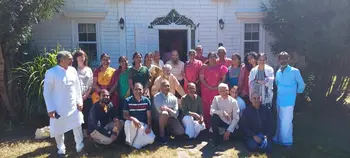
Next, Dennis Hartel presented the history of the Sri Arunachala Ramana Mandir. Originally a one-room schoolhouse built in 1879, the year of Sri Bhagavan's birth, the building was moved some distance from its original site where it stands today. When it was obtained by the Ashrama to be used as the temple, a Herculean effort was mounted by devotees and community members to lift the building up, transport it to the place it now stands, build a foundation, and then place the building on the foundation. Once construction and renovations were completed, the pictures of Arunachala and Sri Bhagavan, which had been presented to the Arunachala Ashrama devotees visiting Sri Ramanasramam in 1973, were installed along with the consecrating pujas and worship. The mandir stands as a testament to the faith and perseverance of Sri Arunachala Bhakta Bhagawata, founder of the Arunachala Ashrama.
Several of the devotees present today had recently undertaken an inspired pilgrimage to Mount Kailash. The highlights of this divine yatra were shared by Nimmi and Shridhar Bharadwaj. The dedication of the pilgrims undergoing the physically arduous but spiritually uplifting journey culminated in the divine darshan of Mount Kailash, followed by a visit to Lake Manasorovar. The beauty of this pilgrimage cannot be overstated. Between the above presentations, musical offerings by devotees were appreciated. Among those praising Sri Bhagavan in song were Sangeetha Swaminathan, who sang Muruganar's exquisite verses from Sri Ramana Sannidhi Murai, and Janaka Sudha, who sang Janaki Mata's praise of her guru. A beautiful commorative souvenir for this occasion was handed out to each family by Sriram, Manjula and Aparna.
After the concluding offerings and aarti, devotees returned to the ashrama house to enjoy the prasad that had been prepared by the devoted cooks, who, as in Sri Bhagavan's time, worked tirelessly with great enthusiasm to feed the large number of attendees. Sri Bhagavan's grace was clearly palpable during the festivities, and now, as then, his grace will continue to guide his devotees to the fulfillment of life's purpose, to remain established in our own true nature.
Kailash Parikrama
Part One
A total of six sincere devotees from Georgia, North Carolina and New Jersey dedicated several months to prepare themselves physically and spiritually for a pilgrimage to holy Mount Kailash in the month of June this year. We humbly requested one of the pilgrims to write us a detailed description of the preparation and execution of this quest into the heart of the Himalayas. And, in this three-part series, she has graciously provided us with an honest and inspired account of the extreme physical challenges encountered and spiritual rewards vouchsafed on this once-in-a-lifetime spiritual journey.
om namo bhagavate śrī ramaṇāya
My journey to Kailash started from a Ramana Satsang at our home. Three years ago, a Bhagavan devotee who attended satsangs at our home regularly shared that she had completed the Kailash Parikrama three times on three different occasions. I was amazed that what seemed like an impossible dream for me could be done multiple times by this young woman. I made a silent prayer to Bhagavan that I should at least complete this pilgrimage once in this lifetime. I did some research and spoke to the travel agent used by my friend but was unable to finalize any plans.
So, when my brother Shridhar told me in early 2024 that he was planning a Kailash Parikrama pilgrimage with a few other Bhagavan devotees and that I should join, I knew this was a calling from Lord Shiva himself. Later, I would learn that the trigger for this Kailash plan was a determined pact made between two other members of our travel group, Sangeetha and Lavanya, to undertake the journey, and they shared this with my brother and sister-in-law. Our final group of 6 consisted of Sangeetha, her husband Swaminathan, Lavanya Hari, my sister-in-law Nimmi, Shridhar, and me.
The Preparation is the Journey
Once we set the goal, almost a year before the actual journey, it seemed to take over our psyche and started to guide our thoughts and actions in subtle ways. For me, it was a sadhana. In the months leading up to the journey, each of us had different challenges. Health concerns, visa issues, and demanding family situations were all overcome with the grace of Bhagavan. Six months before the start of the trip, the itinerary was finalized, and soon after, the air tickets were booked. Shridhar was in frequent touch with the travel agency and acted as the primary liaison for our group. We were to fly to Beijing, China, and from there take another flight to Lhasa, the capital of Tibet. Mount Kailash lies in western Tibet, and to reach the base of the mountain, we would travel from Lhasa by road for 3 days, driving approximately 8 hours each day. The hill, which is sacred to Hindus as the abode of Lord Shiva and Mother Parvati, is also considered very holy in Buddhism, Jainism and the Bon religion.[1]
The 90-day mark before our departure sparked more earnest communication among the six members of our group, spread out in 3 different cities. We formed a group chat, and this quickly became an essential means of planning, motivating each other, sharing trivia and reading materials about the Kailash region. This was also where Lavanya's husband, Hari Moorthy, the honorary member of our group, would regularly post verses of the Tamiḷ Saivite saint, [2]

We reached Lhasa on June 4th, 2025, and were welcomed by our tour company at the airport with ceremonial Tibetan white silk scarves. Lhasa is situated at an elevation of 11,800 feet above sea level, and we immediately felt the effects of the high altitude. For our group, shortness of breath and slight headaches were the only symptoms. We had started taking our altitude sickness prevention medicine the previous night and continued to take it till the completion of the Parikrama. The medicine, as well as spending the first 3 days in Lhasa acclimatizing to the higher elevation, contributed significantly to the success of the journey. Nimmi and Shridhar, being physicians, were able to guide us throughout the trip whenever any medical questions arose.
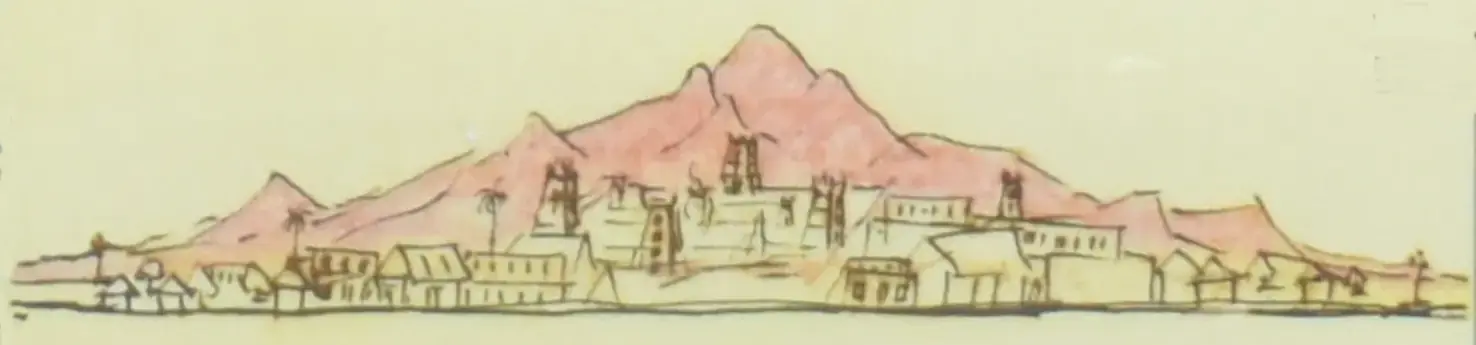
At our hotel in Lhasa, there awaited a very special and most unexpected treat. As soon as we entered the lobby, through the large windows at the far end, we could see a mountain bearing an uncanny resemblance to Arunachala. It was as if Annamalaiyar was waiting for our arrival to guide us on this journey. The sight delighted us each time we saw it during our 3-day stay there, and it was a quiet reminder that Bhagavan's blessings were with us every step of the way.
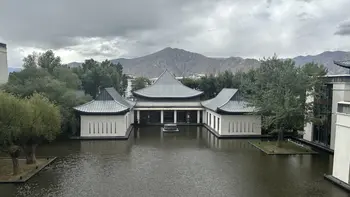
We met our excellent guide, Tashi, that evening. He was full of energy and had a great sense of humor, but what we did not know then was that he was also a Sadhak, a spiritual seeker himself. A Tibetan Buddhist, he was deeply interested in spirituality and had a questioning mind. Tashi shared his extensive knowledge of Tibetan Buddhism with us during our time together and was curious to know about Advaita philosophy and our Bhagavan's teachings. It often led to deep conversations with him throughout our travels.
On day one of our sightseeing in Lhasa, we got into the large van, which was to be our faithful companion for the next 2 weeks. After installing a small photo of Bhagavan inside, we started the day by chanting Aksharamanamalai. One of the first things we saw upon leaving the hotel was the beautiful Yarlung River flowing through the city. Originating near Mount Kailash, this is the same river which after being joined by several tributaries, crosses over into India as the mighty Brahmaputra. Immediately, we felt the spiritual and cultural connection between our countries and felt at home in the enchanting city of Lhasa.
Lhasa is also the spiritual capital of Tibet. The holiest temple for Tibetan Buddhists, the Jokhang temple, lies at the heart of the city. The most sacred pilgrimage destination for believers, it houses the divine statue of Buddha Sakhyamuni, an image of 12-year-old Buddha, believed to have been made during the lifetime of the Buddha. Driving through the city we saw pilgrims who were coming from all over Tibet, circumambulating the holy city itself. The Kora pathways are clearly marked, and it immediately reminded us of the Giripradakshina path around sacred Arunachala and Arunachaleshwara temple. The simplicity and devotion of the local people were moving to see. Dressed in traditional clothing, almost everyone we saw had prayer beads in their hands, chanting their mantras quietly. We saw this throughout the city, reminding us that we were on holy ground that has been venerated for generations.
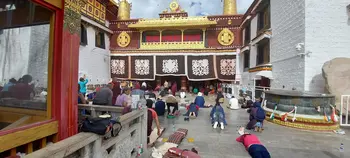
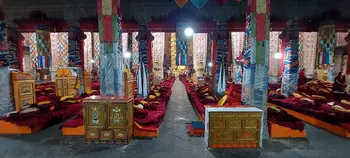
Over the 3 days we spent in Lhasa, we were very fortunate to visit ancient monasteries which are still active and thriving. Some highlights were the Drepung monastery, where the vibrations in the chanting hall were palpable. The monks had just left the hall after their prayers, and our group was blessed to be able to sit at the back and chant Bhagavan's Upadesa Saram. It was a thrilling experience we will never forget.
At the Sera monastery, we saw young mothers bringing their newborns for blessings of good health. We also witnessed the sonorous chanting of the monks of the monastery in an open courtyard shaded by large trees. Along with other visitors, we listened mesmerized by the divine intonations which reminded me of Vedic chanting. The visit to the imposing Potala Palace was bittersweet for me, knowing that His Holiness, the current Dalai Lama, cannot grace this historical institution at this time. The palace is a very popular tourist destination as well as a sacred site for Tibetans. We learnt about its history and spiritual significance from Tashi and admired the grandeur of the palace.
At the Jokhang temple (as mentioned earlier, the holiest temple for Tibetans), we were able to perform the Kora around the shrine. Spinning the prayer wheels along the Kora path, I chanted om namo bhagavate śrī ramaṇāya and Om Namah Shivaya, praying for our successful completion of the Kailash Parikrama. Sangeetha offered the song 'Saranagathi' soulfully at the main shrine, and after that, we all joined her in singing the Bhagavan bhajan, 'Gangadharahara'. It was a very fulfilling and blessed visit.
On the final day in Lhasa, we visited the Ganden Monastery. The Kora around the monastery, which is at an elevation of 14,000 feet, gave us a taste of what hiking at such altitudes would be like during our Kailash Parikrama. From there the views of the Lhasa valley with snow-covered mountain ranges in the distance were spectacular. Towards the end of the path lay the Great Tsongkhapa's (founder of the monastery) meditation cave, very reminiscent of the Virupaksha cave on Arunachala. We were able to sit quietly in meditation for some time in this cave.
Divine Dreams
Sometimes we wake up with a vague memory of a dream in which we meet friends, travel to places known or unknown, are chased, troubled by someone or even help someone. The experiences in such common dreams usually quickly melt away with the waking-state occupying all our attention.
But there are exceptions, like the ones related below. These are of a different nature – authentic, vivid, and can even be called ‘divine’. They serve to inspire our aspirations and confirm the presence and guidance of a higher power in our lives.
Arunachala is Everywhere
I would like to share a condensed version of a very vivid, detailed dream that I had recently.
It has long been a desire of mine, not just to visit the Tiru ashram but to live there permanently, though I knew this was no longer within the realm of possibility. In my dream a Tamiḷ Nadu man I knew (he had been our van driver on a previous waking-state pilgrimage to T.N. in 2004) came and said he was to accompany me in my move to the ashram, that Dennis Hartel had arranged everything and was paying for everything. I left immediately with him without even packing. We flew to L.A., to Kuala Lumpur, to Chennai; from there, Kannan drove me in an old Army Jeep to the ashram where Anand and an old woman welcomed us. Kannan left, and Anand said the woman would show me around the ashram, which she did; everything was very familiar at the foot of Arunachala from having read and seen photos and visited there. After the lengthy, detailed tour, the old woman said she would take me across the street and show where I was to live. We crossed the busy street to a small house, and when we went through the door, it was my little apartment here in the senior living facility in Muskego, Wisconsin, USA, where I live now. What a wonderful dream – and lesson – Bhagavan gave me.

That Moment Changed My Life
Bhagavan once appeared in a dream when I was in a dark place and had had a horrible argument with my husband. I have no clue what the argument was about. I was so angry with him that I was sleeping on the living room couch that night. I don’t know if I ever did that before or after, I don’t think so. In my dream, the room was suddenly filled with light and Bhagavan came into the room and came close to me. My body was inside his, his body completely enveloped mine. His body was radiating light and without saying a word he conveyed, “I am always with you.”
I woke up when I received his message. The room was dark and all was well. That moment changed my life.
— an American devotee[1] The Bon religion is one of Tibet’s oldest spiritual traditions – often described as Tibet’s indigenous religion; It existed in some form before Buddhism arrived in Tibet around the 7th Century.
[3] Sister Kathleen is an elderly Dominican nun
Ramana Satsangs
Satsangs with recitations, songs, readings and meditation have been going on in a few places near or in large cities. Some of them are weekly. If you would like to attend any of these, please see the Sri Ramana Satsang online pages. channel.