

Kailash Parikrama, Part 2
As the trek around Mt.Kailash, the abode of Siva, continued, it was apparent that the grace of Sri Ramana Maharshi was guiding the devotees. From the sacred flag pole raising ceremony at Darchen, the throng of pilgrims wound their way to Dirapuk and on to Dolma La Pass, the highest point in their journey. Despite tremendous physical challenges, including altitude-related breathing difficulties and intemperate weather conditions, the divine name "om namo bhagavate śrī ramaṇāya" and the holy form of Arunachala lightened and inspired their every step.
Onward Journey
After three days of acclimatization in Lhasa, we started the drive westward to the town of Darchen, which would be the starting point of our Kailash Parikrama trek. The journey by road would take us three days by van, with overnight halts in the towns of Shigatse and Saga. Our trusted guide Tashi, Nya-Wang, our skillful driver, and the six of us Ramana bhaktas were in excellent spirits as we commenced the journey which would take us closer to Mount Kailash with each mile we covered. As part of our preparation, Nimmi had come up with an excellent list of shlokas and Bhagavan's compositions that we could chant together. Each morning, we would sing the
Margabandhu Stotram
 as soon as the van started to roll, praying for a safe journey.
Arunachala Stuti Panchakam,
Ramana Stuti Panchakam,
Upadesa Saram,
Siva Puranam and
Siva Panchakshara Stotram
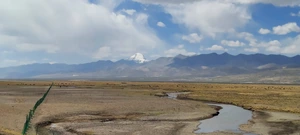
were on our list. The group's regular chanting invoked Bhagavan's holy presence in our midst and helped allay any fear or anxiety we may have had about the arduous trek. It also reminded me how fortunate I was to be undertaking this pilgrimage with fellow devotees of Ramana as my companions. Along the way we stopped from time to time to see places of interest like the turquoise Yamdrok lake and the Karola glacier. The scenery was breathtaking, and trying to spot and point out mountains that resembled our beloved Arunachala became our favorite pastime. On day three of our road trip, we drove through the Ali plateau with the Himalayas looming in the background. A few miles before we reached Darchen, we caught our first glimpse of the Kailash peak. It was hard to believe that after all the anticipation and preparations, we were at last able to see the holy abode of
Shiva.
The van stopped at a designated viewing area, and everyone was thrilled to finally have the sacred peak within sight. Right there, led by Nimmi, our group sang 10 verses from Saint Appar's Thevaram on Kailash. Video calls were made to loved ones so that they could have darshan of the peak, and we left that spot feeling reenergized for the Parikrama trek.
as soon as the van started to roll, praying for a safe journey.
Arunachala Stuti Panchakam,
Ramana Stuti Panchakam,
Upadesa Saram,
Siva Puranam and
Siva Panchakshara Stotram
were on our list. The group's regular chanting invoked Bhagavan's holy presence in our midst and helped allay any fear or anxiety we may have had about the arduous trek. It also reminded me how fortunate I was to be undertaking this pilgrimage with fellow devotees of Ramana as my companions. Along the way we stopped from time to time to see places of interest like the turquoise Yamdrok lake and the Karola glacier. The scenery was breathtaking, and trying to spot and point out mountains that resembled our beloved Arunachala became our favorite pastime. On day three of our road trip, we drove through the Ali plateau with the Himalayas looming in the background. A few miles before we reached Darchen, we caught our first glimpse of the Kailash peak. It was hard to believe that after all the anticipation and preparations, we were at last able to see the holy abode of
Shiva.
The van stopped at a designated viewing area, and everyone was thrilled to finally have the sacred peak within sight. Right there, led by Nimmi, our group sang 10 verses from Saint Appar's Thevaram on Kailash. Video calls were made to loved ones so that they could have darshan of the peak, and we left that spot feeling reenergized for the Parikrama trek.
Kailash Parikrama Day 1
After three days of travel in the van, we reached Darchen, which is at an elevation of 15,300 feet, on the evening of June 10th. The peak of Mount Kailash looms above this small town, which was to be the starting point of our 3-day Parikrama around the Holy abode of Shiva. The town itself was buzzing with spiritual energy as pilgrims who were to start the Parikrama the next morning were beginning to arrive. After dinner, as we walked back to the hotel, with the peak behind us glowing in the golden light of the setting sun, it was almost unbelievable that we had reached the base of the hill after the many months of planning and preparation. Beneath the outer excitement was a feeling of mild apprehension about the difficult trek that awaited us the next morning. After buying prayer flags to offer at the Saga Dawa festival, we returned to our rooms and finished preparing our backpacks for the next morning. We were to carry our water for the day, layers of warm clothing, lunch and snacks to sustain us throughout the day. The items we would need for days 2 & 3, along with sleeping bags, extra food, etc., would be sent by a porter and yak.
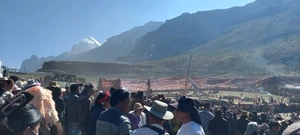
The Saga Dawa festival is the most auspicious time of the year for Tibetan Buddhists. It celebrates the birth, enlightenment and Nirvana of the Buddha. A highlight of the month-long festival is the flagpole raising ceremony at Darchen on the full moon day, which fell this year on June 11th. We had planned our trip such that we could witness this event at Darchen and then start our Kailash Parikrama on this holiest of holy days for the local Buddhists. Thousands of devout Tibetans had gathered at the grounds on the outskirts of the town of Darchen, which was also the starting point for the Parikrama.
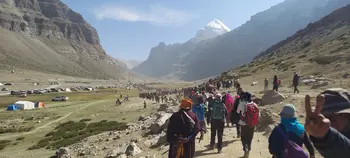
Here we met Adune, a local Tibetan, who was going to be our porter. I did not know at that time that this short, slightly-built gentleman, easy to smile, his weathered face creased with deep lines, would be my benign shadow throughout the three-day hike. With the peak of Mount Kailash blessing us in the background, we added the prayer flags we had brought with us to the giant flagpole. Laden with thousands of flags carrying the prayers of the faithful, it was slowly raised upright with the help of a crane. We too prayed for the blessings of the Buddha and Lord Shiva, passed through a small stupa called Yam Dwar, and began our sacred trek at around 11:00am. There were hundreds of people starting the Parikrama with us that day. With quiet determination and complete trust in Bhagavan, our group started walking. As the day progressed, the crowd would thin out and proceed along the narrow path, each at their own pace.
Excitement was high that first day, and the energy and enthusiasm of our fellow travelers was infectious. It was a bright and sunny day, and though the morning started off cold, as the day progressed, it warmed up to very comfortable temperatures. The terrain on day 1 of the hike was one of gentle ups and downs, but because of the elevation, we would get out of breath very quickly. The strategy to keep moving ahead was to walk at a slow pace so that we would need fewer breaks to catch our breath. Even so, every few meters we had to stop for a couple of minutes and then start walking again once our breathing settled down. It was truly about grit and determination more than anything. Physical preparedness was important, but that first day, it became abundantly clear that we needed faith in the Lord and surrender to His will to complete the trek. Late morning, we took a tea break and then another one in the afternoon for lunch. The rugged landscape was beautiful, and looking up at the Kailash peak from time to time was truly a magical experience. We walked along the valley at the southwestern foot of Mount Kailash, covering 8 miles that day and reached Dirapuk at around 7 pm. From the hostel where we spent that night, we could see the huge rock face of the northern side of Mount Kailash. It was perhaps the closest we got to the summit and the most spectacular and clear view we had of that holy peak.
Our guide was a little worried about the pace at which we had walked that day, and made arrangements for another porter, which would reduce the load in our backpacks. The hostel rooms were shared accommodations with room heaters and warm beds. It had only basic facilities but was relatively new and clean. After a quick dinner cooked by the welcoming staff at the hostel kitchen, our exhausted group went to bed immediately, as the next day we were to have a very early start.
Parikrama Day 2
Day 2 of the Parikrama was going to be the most challenging of the three days. We would start from Dirapuk (El. 17,000 ft), hike up a steep and rocky path to reach the highest point of the Parikrama, the Dolma La Pass, which sits at 18,400 feet, and walk a total of 15 miles that day. That morning, as soon as I woke up, still in bed, I could sense the mighty mountain towering over the hostel in a most benevolent way. A father figure, strong and protective of the pilgrims. It was similar to how I feel waking up in Tiruvannamalai at the foot of Arunachala, Lord Shiva, our father, unmoving, unchanging, and ever-watching over us. It was indeed an auspicious start to the day!
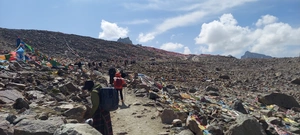
We left the hostel before sunrise, at 6:00am, and from the beginning it was an uphill trek. With temperatures in the 40s, it was a cold morning, but the strenuous walking warmed us up quickly. Low oxygen levels at that elevation, combined with the rough trail, meant each step we took had to be with purpose and care. Stepping over boulder after boulder, our group continued that morning's hike with focus. There was not much talk as we were out of breath from just walking. I was mentally chanting 'Om Nama Shivaya' with each step, and that kept me going. Our porter Adune, who kept a very close watch on us throughout the trip, was always just a few feet away from me. The Parikrama rules require that each porter be assigned to one hiker. At the beginning of the trek, our guide Tashi, almost in jest, had pointed me out to Adune as the hiker he was assigned to. Adune took this very seriously and was by my side throughout the Parikrama. A devout Tibetan, he would be chanting his prayers under his breath constantly, but he knew the mantra, 'Om Nama Shivaya'. Whenever he noticed that I was getting tired or very out of breath, he would come closer and say, 'Om Nama Shivaya' loudly as a form of encouragement. It is hard to put into words what this meant to me during the most challenging phases of the journey. It was as if Bhagavan was with me every step of the way! We did not understand each other's language, but this was never a barrier to forming a meaningful connection. Any time a pony or a yak was close behind us, he would let out a low whistle to alert us, to give way to the animals. Whenever we needed a hand to climb over a particularly high boulder, he would be there to help us up.
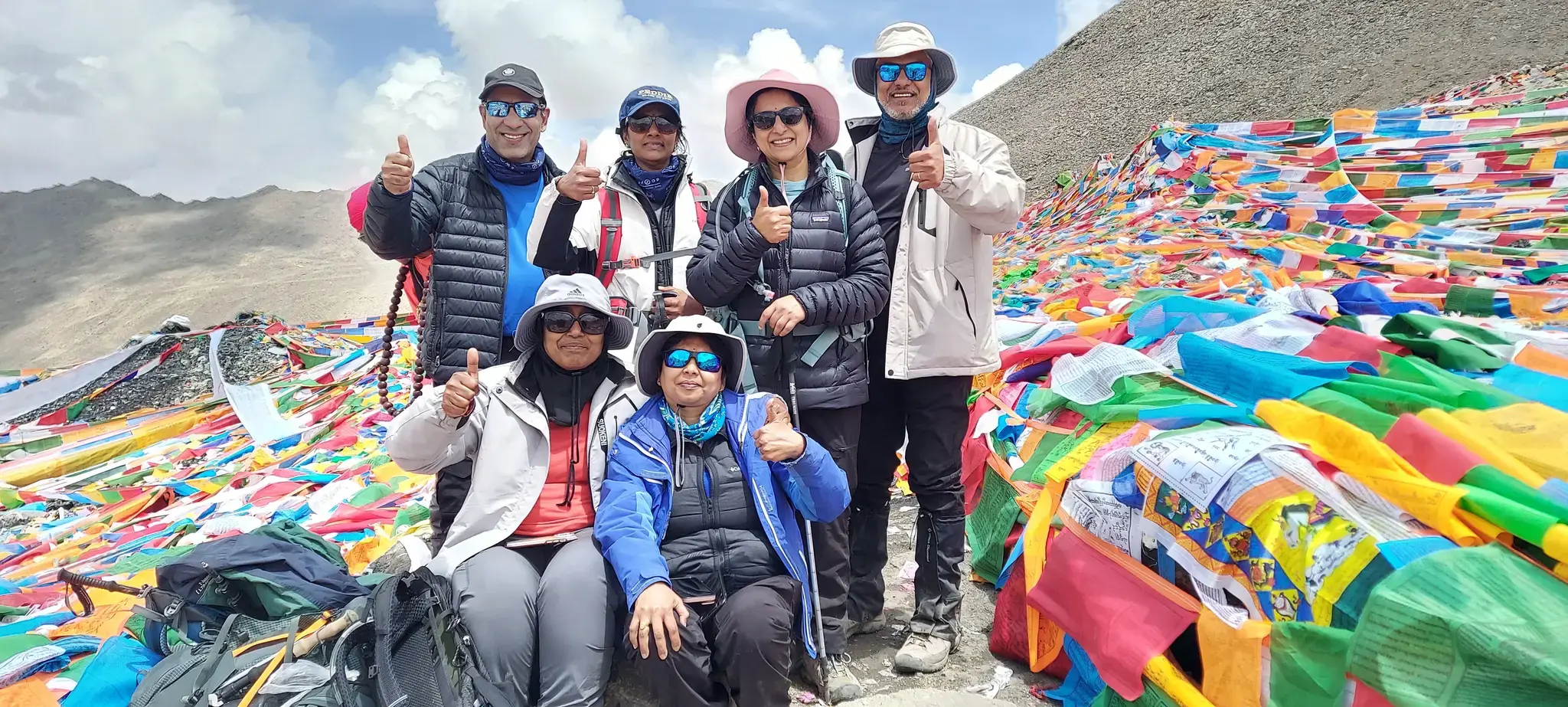
As mentioned earlier, Lavanya, Sangeetha, and I formed one group, and we were almost half an hour behind the lead group of Swami, Nimmi, and Shridhar. The three of us encouraged each other, checking in constantly to make sure we were doing okay. We tried to crack jokes to distract ourselves from the exhaustion and kept a steady stream of candies going to keep up the energy. Our guide, Tashi, also kept a watchful eye on our group. He would walk with us when we needed encouragement and try to convince us that the next pass above us was the highest point, and it was only downhill after that. Of course, this was to keep us going, and there were several such passes before we reached the highest point of the Dolma La Pass at around noon that day! It was an exhilarating feeling, rejoicing and broad smiles were on all the hikers' faces. The pass was covered with prayer flags, and we spent several minutes among those colorful flags fluttering in the wind, carrying with them prayers of the devout to the heavens.
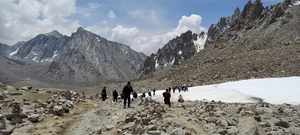
Coming down from the pass, we saw the sacred Gouri Kund lake and soon after we had to walk over a large section of a frozen stream. It was slippery and slushy in places and proved to be a fun adventure. Soon afterwards, the path started to go downhill very steeply. It was an arduous climb downwards as the rocks and dirt below would slip and slide with each step. Adune helped me down each boulder slowly, while behind me, Tashi was helping Sangeetha. We were in a single file as the path was narrow, with Lavanya at the back end. As Lavanya struggled to get a foothold each time down that treacherous stretch, a young Tibetan lady pilgrim, appeared next to Lavanya and offered to help. The pilgrim held Lavanya's hand and guided her safely down the steep slope. At the end, when Lavanya offered her some money, the lady vehemently refused to take it and was gone in a flash. It was nothing short of a miracle. We had no doubt that it was Bhagavan who had appeared in the form of that pilgrim and helped Lavanya during that crucial time.
It was 3:00pm when we stopped for a lunch of porridge and steamed buns at a teahouse. We had been walking for 9 hours at that point, and when we realized that we had another 4 to 5 hours of walking to do that day, I didn't think I could do it. Completely drained of energy, it seemed impossible to continue that day. Once again, it was from our group of determined devotees that I got the courage to get up and resume walking along the southeastern valley of Mt. Kailash. It was nearly 8 pm when we reached the hostel near the Dzultripuk Monastery that night. Too tired for dinner, I went straight to bed and woke up refreshed the next day. It was purely Bhagavan's grace that all the exhaustion had just vanished, and our group was excited to start walking for the 3rd and last day of the Parikrama.
— to be continued in the Jan/Feb issue
Uḷḷadu Nārpadu
உலகுமெய்பொய்த் தோற்ற முலகறிவா மன்றென்
றுலகுசுக மன்றென் றுரைத்தெ – னுலகுவிட்டுத்
தன்னையோர்ந் தொன்றிரண்டு தானற்று நானற்ற
வந்நிலையெல் லார்க்குமொப் பாமூனே – துன்னும் 3
Ulagu-maipoi tōṭṭram ulagari-vām anḍṛen-ḍṛu
Ulagu-sukam anḍṛen ḍṛurait-ten – ulagu-viṭṭu
Tannai-yōrn donḍṛi-raṇḍu tānaṭṭṛu nānaṭṭṛa
Annilai-yel lārkkum oppā-mūnē – tunnum [3]
உருவந்தா னாயி னுலகுபர மற்றா
முருவந்தா னன்றே லுவற்றி – னுருவத்தைக்
கண்னுறுதல் யாவனெவன் கண்ணலாற் காட்சியுண்டோ
கண்ணதுதா னந்தமிலாக் கண்ணாமே – யெண்ணில் 4
Uruvan-tān āyin ulagu-para maṭṭrām
Uruvan-tān anḍṛēl uvaṭṭrin – uruvat-tai
Kaṇṇuṛu-dal yāva-nevan kaṇṇalār kāṭchi-yuṇdō
Kaṇṇadu-tān anda-milā kaṇṇāmē – yeṇṇil [4]
3. ‘The world is true!’ – ‘no, it is a false appearance’; ‘The world is mind!’ – ‘no, it is not’; ‘The world is pleasant!’ – ‘No, it is not’. What avails such talk? To leave the world alone and know the Self, to go beyond all thought of one and two, this egoless condition is the common goal of all.
4. If Self has form, the world and God likewise have form. If Self is without form, by whom and how can form (of world and God) be seen? Without the eye, can there be sight or spectacle? The Self, the real eye, is infinite.
– Forty Verses on Reality (Uḷḷadu Nārpadu)
The Old Hall and the Tampa Retreat
“The Old Hall Rises in the New World,” declared the Jan/Feb 2017 edition of 'The Maharshi' newsletter. By the dedicated efforts of Dr.Palani Rathinasamy and Smt.Mathy Rathinasamy, eight years ago an exact replica of the ‘Old Hall’ in the West was inaugurated for the use of Bhagavan Sri Ramana Maharshi’s devotees. Many who step into the Old Hall at Tiruvannamalai attest to the Divine Presence felt, where Bhagavan spent nearly 23 years sitting on the sofa radiating peace and grace. Devotees who enter the new ‘Old Hall’ in Tampa experience that same peace and grace.
In December 2013, the first Jayanthi retreat was organized in Tampa with roughly 60 participants. The inspired description of this retreat, which appeared in The Maharshi newsletter began attracting more participants in the subsequent years.
Now, it has been a tradition for nearly 11 years (with the exception of ‘COVID years’) for many devotees across North and South America to assemble for a few days in and around Tampa for this annual retreat. Some of the past talks at the Tampa retreat are still available on YouTube.
In 2023, the Tampa retreat resumed under the auspices of Sri Ramana Maharshi Heritage Foundation after a three-year hiatus, primarily due to COVID-related travel restrictions. With nearly 60 participants, the 2023 retreat was a testament to Maharshi’s living presence among his devotees. The event was organized at the Marriott Center, due to policy changes at the previous retreat venue. As Bhagavan once told a devotee that happiness could also be found in busy centers and not just in forests because the real happiness is in the Self, the devotees at the 2023 retreat felt the same peace even in the commercial hall. With Dr. Anand Ramanan, the president of Sri Ramanasramam, in attendance, the event also marked the conclusion of the year-long Sri Ramanasramam Centenary Celebration.
The 2024 retreat took place from December 27-30, with an attendance of 60 sincere devotees, traveling from various parts of the US, Canada, and South America. We have to limit the number of participants this year. So we request devotees interested to register soon.
146th Ramana Jayanti Tampa Retreat
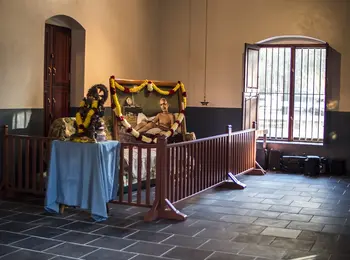
This year’s retreat will have periods of meditation, chanting, readings, presentations, satsang and quiet time for reflection and relaxation, and will take place at the Conference Center at Ashlyn Park in Tampa, Florida. Additional programs will be held at the new Old Hall and the Hindu Temple, both located on Lynn Road in Tampa. A program to engage the children in spiritually-oriented activities is also scheduled. Participants are requested to arrive Sunday afternoon by 3:00pm to attend the special Arunachala-Ramana puja at the Hindu Temple starting at 4:00pm.
Please register for the retreat and for hotel accommodation. There you will also find a link for payment through PayPal.
If you have any questions, please feel free to contact Shridhar Bharadwaj at 404-354-2708/ shri.bharadwaj1@gmail.com
The maximum occupancy of the Conference Center is 75 guests. The final registration date is November 30th.
Sri Kunju Swami and Bhagavan's Glance of Grace
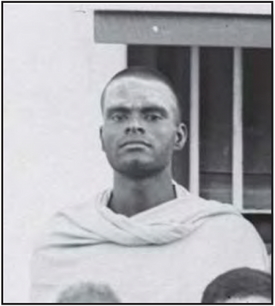
It was in 1919 that I first came to Sri Bhagavan.[1] He was then living at Skandasramam on the slope of the Arunachala Hill. His mother and brother lived with him. Palaniswami used to attend to his few personal wants. Plague had dríven away most of the inhabitants of the town and consequently visitors to Sri Bhagavan were very few. I was therefore, left alone with Sri Bhagavan most of the time He used to look at me and his eyes had, as is well-known, a strange brilliance and fascination in them. When I had looked into his eyes for some time I saw a bright effulgence. I could not say whence it came but it had the effect of making me forget everything. It was not like sleep for I was fully aware. I was also filled with a strange peace and bliss. I came back to myself with a shudder after some time. This experience occurred again and again during all the seventeen days that I stayed with Bhagavan. I was like one intoxicated. I was absolutely indifferent to everything. I had no curiosity to see anything, no desire whatsoever. What I did I did most mechanically. I would have continued to live in this state if it had not occurred to me that it was not proper to partake of the food that was offerred to Sri Bhagavan by his devotees without paying anything. I thought that he had initiated me into the experience of Brahman and that I had nothing more to gain by staying in his presence. I therefore returned to my native place and began to practise meditation in a room in my house all by myself. I could succeed to gain and retain that experience only for a few days; it started to diminish gradually and at last one day it was lost. I could not regain the experience. I decided to return to Sri Bhagavan. This I did, and great good fortune awaited me when I came.
I, however, asked Bhagavan why I could not get the experience when I meditated in my house. Bhagavan said: "You have read Kaivalya Navaneeta, have you not? Don't you remember what it says?" And he took up the book and read the relevant verses.
Sri Bhagavan then explained to me at great length the purport of these verses. They relate to the doubt raised by the disciple about the need to continue spiritual practices even after one has had the supreme experience. The disciple wonders whether the spiritual experience once gained could be lost. The Guru says that it would be until he took care to practise śravaṇa, manana and nididhyāsana, that is hearing from the Guru the Truth, reflecting over it and assimilating it. The experience would occur in the presence of the Guru, but it would not last. Doubts would arise again and again and in order to clear them the disciple should continue to study, think and practice. These would be done until the distinction of the knower, the object of knowledge and the act of knowing no longer arise. In the view of Sri Bhagavan's explanation I decided to stay always by Bhagavan's side and practise śravaṇa, manana and nididhyāsana.
– 'The Mountain Path', July 1968Monica Bose Remembers Sri Ramana Maharshi
When she first saw Sri Ramana Maharshi, Monica Bose was a 12-year-old school girl. When she saw him for the last time she was a young woman of twenty-two. In the intervening decade, she spent her school holidays in Tiruvannamalai and was a daily visitor to Sri Ramanasramam. Today Monica Bose is perhaps the last person alive who can claim such a long association with Sri Ramana. In this video she shares her recollections and explains what it meant to grow up in the presence of Sri Bhagavan.
Earlier this year, Louis Buss in England sat with Monica Bose in her home and recorded the remarkable story of her early life in Tiruvannamalai. Her book, Hill of Fire, published in 2002 tells the story of her accomplished and adventurous mother, Dr.Sujata Sen, whose life ultimately gravitated around the Sage of the Holy Hill of the Beacon Light, Sri Ramana Maharshi. At the advanced age of 97, Monica Bose still recalls with extraordinary clarity and grace all the major events and experiences of her youth living with her mother in Tiruvannamalai.
In this  video,
she says of Sri Bhagavan: “There was a very special atmosphere about him that you felt at once. Even as a child, I felt it. I thought that he was so peaceful, and so loving. And at the same time, I felt a power in him. And when he looked at me, I didn't know what to do with that power...It was so strong. So he was both very powerful, and very loving. And when he speaks of the loving intelligence, that describes him perfectly.”
video,
she says of Sri Bhagavan: “There was a very special atmosphere about him that you felt at once. Even as a child, I felt it. I thought that he was so peaceful, and so loving. And at the same time, I felt a power in him. And when he looked at me, I didn't know what to do with that power...It was so strong. So he was both very powerful, and very loving. And when he speaks of the loving intelligence, that describes him perfectly.”
We are indebted to Louis Buss for this video, which in addition to his exhaustive research into the life of Major A.W.Chadwick, which was compiled into the book, 'The Centurion', continues to provide us with his inspiring works, dedicated to our Guru, Bhagavan Ramana.
[1] also produced in As I Saw Him, #3