

Bhagavan and Sunyata
Born on a small Danish farm in 1890 with the name Alfred Julius Emmanuel Sorensen, the future Sunyata had two sisters, aged twelve and fourteen, at the time of his birth. Educated only up to the eighth grade, he would often joke that he had “escaped headucation,” a term he used to refer to most education as a kind of mental conditioning that keeps attention focused on the external world.
During his youth, a great shock occurred at the age of fourteen when the family farm was sold to strangers who had no respect for the land. He began an apprenticeship in horticulture and eventually moved to England where he became what he referred to as “a simple gardener.”
As a gardener, he worked in England from six in the morning to six in the evening on large estates such as Forty Hall, Sunbury Court, Hampton Court, and Dartington Hall. While he was working in the gardens of Dartington Hall in Devonshire, Rabindranath Tagore, the Indian poet, came to speak.
Emmanuel, whose name means “the indwelling God,” his favorite name for himself, played a Beethoven quartet for Tagore on an old gramophone. Tagore was so impressed with the quality of Emmanuel’s silence, his lack of willfulness and egoic desire, that he invited him to come to India to teach silence. But how can you teach something except by being it? Being it, he was.
His arrival in India in 1930, in his fortieth year, marked the beginning of a new phase in his life’s drama. People immediately thrust titles upon him, such as Baba, Saint, and Guru, but none of these names seemed true to his being. He did accept small gifts from people but refused them if they were more than he needed at the time. For forty-five years he lived in India where his work was simple: just be. His days as a gardener became a thing of the past. Everything was given to him. In his words, “We live so close to Heaven.”
When he arrived at Ramana Ashram in 1936 and first met Sri Bhagavan, Emmanuel soon realized that he had never met such quality of consciousness in any living being. Later in his life, he said of this meeting: “Never had I awared[1] such integral Self-radiance in any human form, such light of silence. One was being fed just awaring him. At first sight of him, I felt no excitement or even awe, no solemnity or ecstasy, simply a calm recognition, a glad contentment and gratitude in his darshan.”
He had heard of Sri Ramana Maharshi while in Kashmir and Tibet from lamas, and later from Paul Brunton and Dr.Evans-Wentz. But only after spending several years in the Himalayas, did he come to the Maharshi, and visited him three more times after that.
When Emmanuel first arrived, Ramana asked him his name and nationality, and inquired about mutual friends and his sadhana. That was the way he had come. Emmanuel was put up in one of the ashram guest houses, and during his two-week stay he spent many of his days sitting in the back of the meditation hall, soaking in the quality of Ramana’s radiance.
Unlike most of the other Westerners who came to visit the ashram, Emmanuel did not ask even one question. Other than his responses to those few initial questions from Ramana, there was no verbal communication between them.
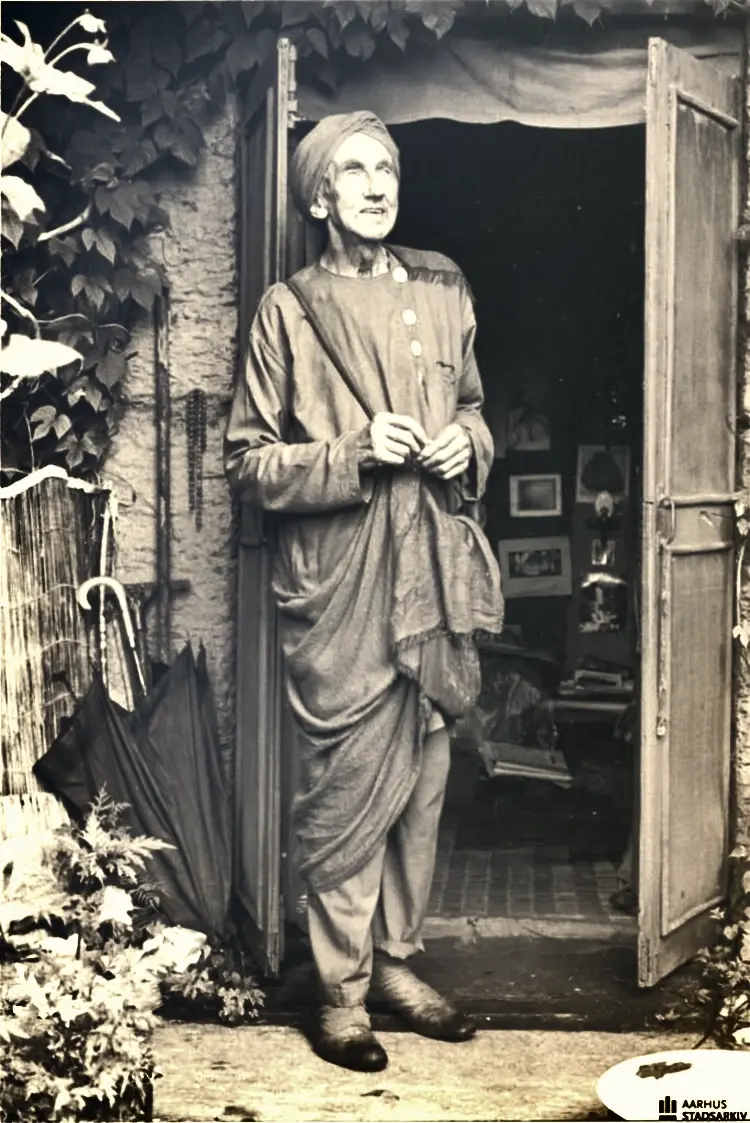
Emmanuel was therefore quite surprised when he later heard from Paul Brunton that, soon after his departure, Ramana had referred to him as a janma-siddha, one of the rare-born mystics.
When Emmanuel heard this phrase, “rare-born mystic,” he had no idea what a mystic was, or what it meant to be one who was rare-born. Emmanuel soon acquired a copy of The Oxford Book of English Mystical Verse in hope of finding out what it meant to be a mystic. At the same time, he began to examine his own childhood to see why he had been able to loosen his identification with ego-consciousness so easily. This exploration became the origin of the reflections called “Memory,” or “True Recollection,” which became his book.
It was during Emmanuel’s visit to Ramana Maharshi in 1940 that he acquired the name he would use for the rest of his life. He was sitting quietly in meditation when he awared, in effulgence, a spiritual flood of light especially radiated and directed upon his form. Suddenly, out of the silence, came an unsolicited, telepathic-like message from Ramana Maharshi in the form of these five English words: “We are always aware, Sunyata.”
What surprised him most in this message was the word “always.” Although he had often transmuted Shakespeare’s phrase “ripeness is all” into his own saying, “awareness is all,” up to that moment he had never realized that who he was is always aware.
He also asked himself, “Who is this we?” Did it mean Ramana Maharshi and himself, or did it include everyone? Eventually he realized that “we” is the indwelling innerstanding.
Another surprise was that Ramana, a Hindu sage, had used the Buddhist term “sunyata,” often translated as “the void” or “full, solid emptiness.” The Buddhist doctrine of sunyata asserts that all beings and phenomena are free of any soul or intrinsic nature.
This means that although people, things, and events appear outwardly to be real and substantial, in actuality, when inwardly known, they are simply ephemeral and insubstantial.
Sunyata took Ramana’s five words as recognition, initiation, mantra, and name.
Thereafter, he referred to both himself and the hut in which he lived as Sunyata. Like a crystal that reflects many colors yet remains pure, clear, and unaffected, that is who he would always be: nothingness. Tat tvam asi. That Thou art.
He later elaborated on the first darshan with the Maharshi, saying that it was an unforgettable experience. Sri Ramana’s casual statement, “We are always aware,” made a powerful impact on him. It resounded in consciousness like a chime and continued to linger in his memory like a mantra or echo.
He later said, “I found Ramana Maharshi was a pure advaita experience, and his chief language was radiant silence, to which only mature souls familiar with solitude could easily respond.”
When Sri Ramana was questioned by officious officials and was later asked if it had tired him, he said, “No. I did not use my mind.”
For the next four decades, Sunyata continued to live in his Himalayan hut near to Almora. About this new home, he said, “I was contented in Denmark, though I could see the others regarded me as an oddity. In England I felt freer. In India I felt at home. But in the Himalayas, I feel closest to Heaven.”
During all those years in India, he was never employed but found money being pushed on him. He was offered twenty rupees a month, about $22.50 U.S. at the time, but accepted only five. Then, in 1950, the Birla Foundation in New Delhi, whose purpose was to assist saints and sadhus, asked him if he would accept one hundred rupees a month. He agreed to accept twenty, later saying, “It was more than I needed at the time, but I thought prices might rise.”
It was later raised to fifty rupees, where it remained for more than twenty years. Even after inflation made it hard to live on fifty, Sunyata would never consider asking for a raise.
Living near his Himalayan hut on Crank’s Ridge were neighbors such as the Tibetan Buddhist scholar Lama Anagarika Govinda and Dr.Walter Evans-Wentz. He would often make pilgrimages to the plains of India during the winter season and return to his hut high in the mountains when the plains began to sizzle with summer heat.
He became personally acquainted with such leaders of the Indian independence movement as Mahatma Gandhi and Jawaharlal Nehru. He also came to know Anandamayi Ma, Neem Karoli Baba, and many realized beings who where then unknown in the West.
He later said of his sadhana: “In my sadhana the invisible monitor told me, ‘From today you are not to make obeisance to anybody.’ Later, I again heard the voice within myself, which told me, ‘Whom do you want to bow down to? You are everything’.” At once he realized that the universe was, after all, his own manifestation. Partial knowledge then gave place to integral, inherent wisdom, and he found himself face to face with advaita, the One that appears as many.
He further stated that during this period many vibhuti powers were manifesting, though, to anyone’s knowledge, he told no one about this during his life. Sunyata seems to have had, among others, the siddhi that naturally appeared as healing touch. He described how he found that whenever he touched a patient in need, that individual would be immediately cured. He said he tested this on several people and found it to be invariably true.
The story of Sunyata’s stay in India would not be complete without mentioning his plucky black-and-white dog named Wuti. Wuti came from Tibet in a sack along with a lion cub in 1950 and became Sunyata’s constant companion for the next nine years.
Sunyata named him Wuti because that was the sound he made when he barked. When the Indian saint Anandamayi Ma looked at Wuti, she announced, “This is not a dog.” Thereafter she permitted Wuti into the inner sanctum of her ashram, where no dogs were allowed.
After Wuti died, Sunyata changed Wuti’s name to Wuji and used this term, Wuji, to refer to his own higher self. When Sunyata was asked why he changed the name from Wuti to Wuji, he replied, “Adding ji to a name is what Indians do to show respect. The dog needed less bark and more bite.”
Sunyata would have been happy and content to live in India for the remainder of his bodily life. He never had any desire to go anywhere, let alone to America. But in November 1973, a group of seekers from California associated with the Alan Watts Society went to India to visit Lama Govinda, Sunyata’s friend and neighbor.
A local villager happened to mention to the group that there lived a solitary hermit-type ancient one whom they might want to visit. They went to Sunyata’s hut and decided that indeed he was the enlightened one. One of the group members told him, “You’ll be in California next year.”
Sunyata protested, “But I have nothing to teach and nothing to sell.”
The young man said, “That’s why we want you,” and off he trotted.
Eventually, one of these visitors sent Sunyata a round-trip plane ticket to California, with the promise that, reality-wise, Sunyata need not do anything. When invited to settle in America, Sunyata felt that his life was nearing its end. In his eighties, he had spent much of the previous decades in silence. Yet over time, he had developed a language for expressing his spiritual experience and discovered an unusually strong rapport with Western seekers who visited him in India.
Prarabdha karma, Sunyata once explained, is the karma that cannot be changed in one’s lifetime. So, it was his prarabdha karma to first come to America at the tender young age of eighty-four.
One of the few places in America that had ever really interested him was, coincidentally, California. When he was a young man living in England, he had been exposed to the teachings of the Theosophists, who had spoken about a new race of people being born in several geographical locations, one of which was supposed to be California. And if a new race was born, he wanted to be there for the birthing.
So, for the last six years of his life, he made his home in California, saying, “I take my home with me wherever I go.”
He made no effort to do anything. His mode was simple: to be. Many people claimed that significant changes in their lives occurred after meeting him, but he would always say, “I do nothing. It just happens. Everything always happens rightly. All is right that seems most wrong.”
While crossing a busy intersection in Fairfax, California, on Sunday, August 5, 1984, he was struck by a car. He was taken to a nearby Ross hospital, but by evening he had entered a coma. He lived another eight days but never regained consciousness.– Transcribed from: Sunyata, the Rare-Born Mystic

Encountering Ramana: Emmanuel Sorenson
[1] 'awared' is one of several words Sunyata coined to express his understanding.
The Ribhu Gita
Chapter 26, Verse 2
In the early days when the Maharshi was living on the holy Arunachala Hill, devotees often recited this Tamiḷ translation of the Ribhu Gita before him. He told them that these Tamiḷ verses gave the precise description of his own realized state even before he knew the scriptural terminology. He boldly made the pronouncement that the chanting of this Chapter 26 would bring about samadhi. Hari Moorthy has kindly translated for us this classical Tamiḷ text into English and modern Tamiḷ.
சத்தியசித் சுககனமாய்ச் சலனம் இன்றிச் சகலர்க்கும் ஆன்மாவாய்ச் சாந்த மாகி
அத்துவித பூரணமாம் பிரமத் தின்கண் அலைமனத்தின் விகற்பங்கள் அனைத்தும் தீர்ந்து
சித்தம்அது வேறுஅறவே கலந்தொன்று ஆகிச் சீரசெலம் நியாயம்போல் சேர்ந்து இருக்கை
புத்திரனே தன்மயமா நிட்டை என்று பூரணமாம் அறிஞரினால் புகலல் ஆகும்.
சத்து, சித், ஆனந்தமாய்ச் சலனமின்றிச் சகலருக்கும் ஆன்மாவாய்ச்
சாந்தமாகி, அத்துவித பூரணமாம் பிரம்மத்தில் அலையும் மனத்தின் விகற்பங்கள்
அனைத்தும் அடங்கி, சித்தம் என்னும் இரண்டாவது பொருளின்றி, ஒன்றாய்ப் பாலும் நீரும்
போலக் கலந்து இருத்தலே தன்மயமான நிஷ்டை என்று பூரணத்தை உணர்ந்த ஞானிகளால்
கூறப்படுகிறது. புத்திரனே, அதை உணர்வாயாக.
Cattiyacit cukagaṉamāyc calaṉam iṉṟic cakalarkkum āṉmāvāyc cānta māgi
Attuvita pūraṇamām brahmat tiṉkaṇ alaimaṉattiṉ vikaṟpaṅkal̤ aṉaittum tīrntu
Cittamatu veṟuaṟave kalantŏṉṟu āgic cīrajelam niyāyampol cerntu irukkai
Puttiraṉe taṉmayamā niṭṭai ĕṉṟu pūraṇamām aṟiñariṉāl pugalal āgum
Being of the nature of Sat, Chit, and Ananda (Existence, Consciousness, and Bliss), remaining free from all movements, abiding as the Self of all beings in perfect peace, when all the modifications (vikalpas) of the mind that wander have subsided in the non-dual, infinite Brahman, and without there remaining a second entity called the mind (chittam), one abides inseparably merged with Brahman, as milk inseparable from water, becoming indistinguishably one. This alone is called Tanmaya Nistha (the state of complete identity with That), so declare the sages who have realized the perfection. O son, realize this state.
Someone else asked, “They say that the Jnani conducts himself with absolute equality towards all?”
Bhagavan replied, “Yes! How does a Jnani conduct himself?”
मैत्रीकरुणामुदितोपेक्षाणां सुखदुःखपुण्यापुण्यविषयाणां भावनातश् चित्तप्रसादनम् ॥ ३३ ॥
maitrīkaruṇāmuditopekṣāṇāṃ sukhaduḥkhapuṇyāpuṇyaviṣayāṇāṃ bhāvanātaś cittaprasādanam || 1.33 ||
Maitri (friendship), karuna (kindness), mudita (happiness) and upeksha (indifference) and such other bhavas become natural to them. Affection towards the good, kindness towards the helpless, happiness in doing good deeds, forgiveness towards the wicked, all such things are natural characteristics of the Jnani.
– Patanjali Yoga Sutra, 1:33,
Letters from Sri Ramanasram, #90
Tamiḷ Parayana at Sri Ramanasramam
In detail, Ravi Shridhar describes how a handful of resolute devotees made the six-day Tamiḷ Parayana recordings for Sri Ramanasramam.
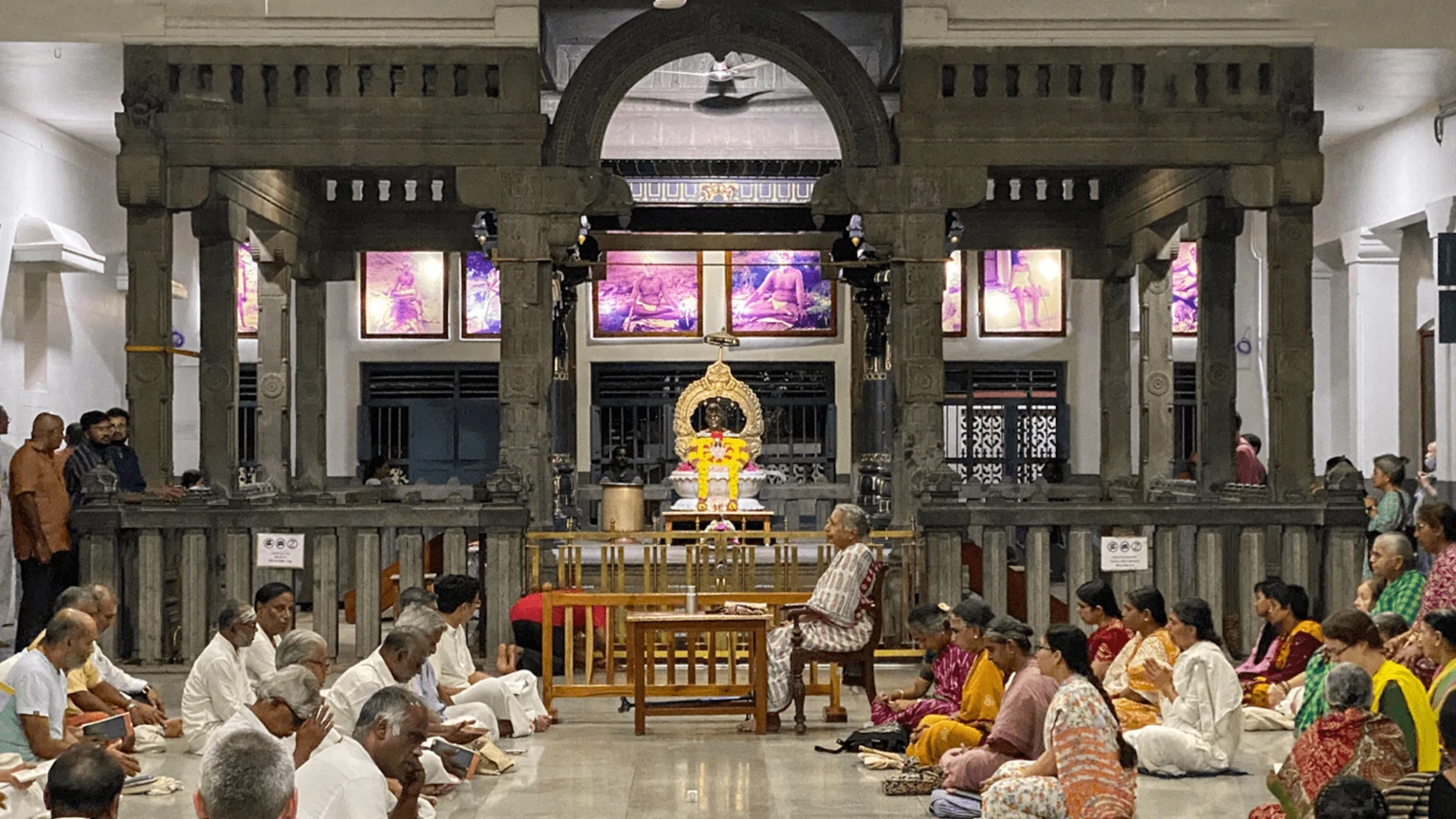
In January of 1998, the British devotee Graham Boyd brought from London a high-end audio recorder with microphones. Boyd was a devotee from the early 1990s, and his first visit was in 1997.
Boyd suggested to President V.S.Ramanan that the six-day Parayana be recorded. This suggestion was broadly endorsed. Though we both (Ravi & Sridhar) were not regularly participating in the daily Parayana at the shrine, we knew the works like the Monday, Tuesday, and Saturday Tamiḷ Parayana by heart. I insisted that we recruit people who could read Tamiḷ, since accurate enunciation was essential for an official Ashram recording. The President agreed, and we selected about eight men and ten women.
Before we could begin the recording, we decided to have daily practice sessions for at least 15 days. For this purpose, we occupied the K12 cottage at Kurangu Thottam and began our practice there. The practice would begin every day after tea at 4 pm and go on for an hour. After 15 days of correcting pronunciations and tunes we were confident that we all had the chanting right.
Now the place where the actual recording would take place had to be selected. I suggested that we all travel to Chennai and record in a studio there. That would ensure the professional quality of the recordings. But Graham Boyd had other ideas. He suggested that we record in the Ashram, and that too in the Old Hall. “We’ll do it every day after the Ashram closes at 9:00pm,” he decided. I was aghast as it was the month of April and summer had already begun with a bang. “We cannot switch on the two fans during the recordings. So, how does one chant in that heat, sweating from head to toe?” was my doubt. Boyd suggested that we record ten verses at a time, switch on the fans for five minutes, and then resume. Everyone agreed to this.
We began with “Arunachala Stuti Panchakam” and finished in two hours. And so, it went on every day after 9 pm. Some of us had important work to do the next day, but we were all very enthusiastic.
The toughest recitations were “Devi Kalotharam,” “Sarva Jnanotharam,” “Bhagavad Gita Saram.” and “Anma Bodham.” These four took almost three hours each to record. As for “Appala Pattu” and “Anma Vidya Keertanam,” the President decided that only those who could sing tunefully should record these two works. Accordingly, Susheela Ramanan, Ramani Mani, Vidya Mami, J.J., Shreedhar and I were selected. It took ten days to make all the recordings.
We took the master tapes to Chennai to have them edited. We selected a studio in Abhiramapuram, opposite the police station. They assigned an audio engineer to us and together we worked every day for about four or five days. This same studio was working on editing audio and video for South Indian movies. The audio engineer who worked on the parayana tracks was then editing a stunt scene for a Tamiḷ movie. And he was a Muslim. Hussain was his name.
At the end of five days, when Hussain handed over the master tapes and the master CD, he said, “Sir, this is the best project I have worked on in my six years of experience in this field. There is something in these chantings that keeps on ringing in my heart.” I mentally asked Bhagavan, “Just look how and from where you pick your instruments!!! Strange fellow you are!!!!!”
We first made one hundred CD copies and then the Ashram bought its own CD copier. The Parayana recordings sold well. Now, of course, they are available free online on gururamana.org
Letters and Comments
Roadblock
I am writing to seek advice. The urge to deepen my understanding is great and I feel like I am at a roadblock. What is clear (intellectually) is that everything that I perceive, I am not. I am that in which everything is perceived. This awareness allows everything within it, unconditionally. The awareness IS, is effortless and all encompassing – the only reality – as everything else within it is transient. The urge or desire is to experience that awareness as myself.
Inquiring who this is that is having this desire leads me to see that it is this body-mind which I have falsely identified as me, and I can see that it is a thought that is establishing this false identity. And even as I am writing this, I can appreciate that it is the thinking that is even creating this ‘roadblock’!
For most of the time when I am sitting in silence, the thoughts are rampant, and I practice keeping my stance as the space in which they arise, and not to get carried away by them. The body experience is strong and feels like ‘me.’ And then, sometimes, it is obvious that I am not the body-mind; and these are very short moments, seldom and fleeting. Could you please provide some suggestions.
— Seeker from PennsylvaniaSo, why do we continue to identify ourselves and the world with thoughts? The reason is desire, vasanas. They are latent and persistent within us, rising, demanding fulfillment, repeatedly. We are slaves to them. They bind us to this world and body. Only when we are devoid of all desires, are we free. It is that simple.
So how to be free of all desire and rest forever in our True Nature, is the next question. Down through the ages religions have expounded numerous methods. But we are fortunate, for the method lived and taught by our guru Ramana is the simplest and most direct. If we consistently study and practice his teachings, we know that the Self is pure Awareness. Our individuality and thoughts arise from that pure Awareness. If we turn within, following the thread of our individual awareness back to its source, thoughts are suspended, peace suffuses our being. If we consciously sink deeper into where the individual awareness issues forth, we lose all awareness of a body, mind and world. Then our pure, natural eternal state eveals itself in all its glory, and That Thou Art (Tat Tvam Asi). This is how we eradicate vasanas.
Bhagavan has said those who have succeeded owe their success to perseverance. So, we must, with devotion and the light afforded to us, practice until inwardness of mind, detachment in action, self-lessness in spirit becomes natural in our daily flow of life. With His Grace fulfilment is certain.
— EditorBhagavad Gita Parayanam
Sunday 1st November 2026
in Arunachala Ashrama, New YorkLed by Vishnubhatla Murthy
Program
- 9:30 - 10:45am Ganeśa Puja, Krishna Abhiśekam,
Rudram, Taittiriya Upaniśad - 10:45 - 1:45pm Bhagavad Gita Parayanam
- 1:45 - 2:00pm Mantra-pushpam & Arati
Followed by lunch prasadam
147th Ramana Jayanti Retreat in Tampa
4:00pm Friday 25 December – 10:00am Monday 28 December 2026
This year’s retreat will have periods of meditation, chanting, readings, presentations, satsang and quiet time for reflection and relaxation, and will take place at Vrindavan Dham Haveli in Tampa, Florida. Additional programs will be held at the new Old Hall and the Hindu Temple. All venues are located on Lynn Road in Tampa.
A program to engage the children in spiritually-oriented activities is also scheduled. Participants are requested to arrive Friday afternoon by 3:00pm to attend the special Arunachala-Ramana Jayanthi puja at the Hindu Temple, starting at 4:00pm.
Please follow this link: https://tinyurl.com/TampaRetreat2026 to register for the retreat and for the hotel booking. You will need to do both. You will also find a link for payment through PayPal.
If you have any questions, please feel free to contact Shridhar at (404) 354-2708.
The maximum occupancy of the retreat venue is 80 guests.